
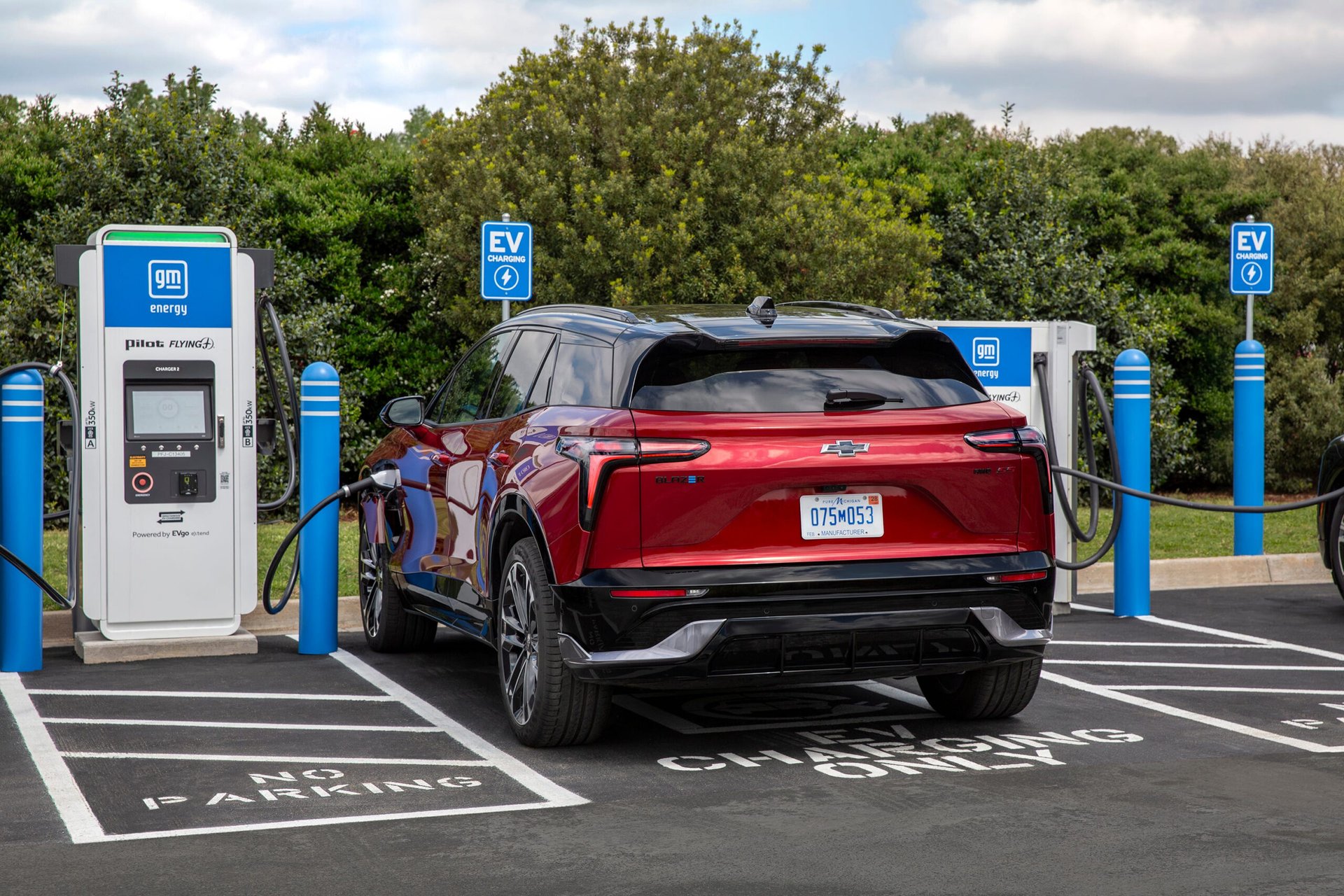
General Motors has found a way to make charging your electric vehicle much easier.
The Detroit automaker said on June 9 at an event in San Francisco that it plans to expand its energy business with several initiatives that include a new phone app feature that allows its customers to access more chargers and pay for energy on a single interface.
GM’s new tool allows EV owners to find and use publicly accessible stations from Tesla Inc., Electrify America, or the automaker joint-venture Ionna through their myChevrolet, myCadillac, and myGMC apps.
The interface, called Energy Pass, covers nearly 70% of all accessible fast charging stations in the United States, GM said Tuesday.
According to GM, the app feature allows customers to:
- Access participating charging networks
- Start and end charging sessions conveniently
- Check live charging status updates from their phones
- See charging history and receipts in one place
- Unlock exclusive discounts at select networks
GM also confirmed that all 2027 model year GM EVs will come standard with North American Charging Standard (NACS) inlets, the same ones that Tesla uses — ports that allow for alternating current (AC) charging, the slower home or workplace charging, and direct current (DC) fast charging more ideal for public charging.
That inlet already comes standard on the 2026 Cadillac Optiq and the 2027 Chevrolet Bolt, GM said, but older GM EVs came with Combined Charging System (CCS) connectors that require a bulkier plug that separates the fast and slow charging ports. The old plug also required an adaptor to use NACS chargers.
Additionally, an over-the-air update in Energy Pass is expected later this year for Plug & Charge capabilities — where customers literally pull up to a station, plug in and charge while payment is handled in the background — on the Tesla Supercharger network. GM customers can use those features with Ionna stations and EVgo chargers right away.
GM said the rollout of NACS inlets will continue through the launch of 2027 model year vehicles across the remainder of 2026.
GM Bets on Bidirectional Charging
At an event called GM Empower, the Detroit company also outlined initiatives to improve the batteries it makes that are intended for energy storage and to help relieve the strain on America’s existing energy grid.
Automakers that have expanded into energy storage systems see great business potential in bolstering the already strained energy grid amid the rise of data centers. GM said it is looking to its active electric vehicle customers and the home charging systems it sells as a possible solution to lower electricity costs.
GM is releasing a firmware update that gives current GM Energy vehicle-to-home systems full vehicle-to-grid capabilities, allowing electric vehicle owners to pull energy from the power grid and give it back along the same route. That way, when demand is higher on the grid, the utility company could buy back energy from participating GM customers, lowering their bills.
GM spokesman Stu Fowle said that the company does not share how many GM Energy systems it has sold to customers but said the amount active could be quantified “in the thousands.”
Customers who already own the equipment receive the upgrade automatically.
Alongside a similar pilot in California, GM said it is also stress-testing bidirectional charging at 30 of its employees’ Michigan homes in collaboration with DTE Energy.
In an open letter to American utility companies and regulators, Wade Sheffer, vice president of GM Energy, said the benefits of sharing energy between electric vehicles on the road and the grid justify the considerable effort it would take.
“This transition won’t be easy, and we deeply respect the challenge of balancing day-to-day grid reliability with rapid innovation,” Sheffer said. “Implementing new functionalities, from interconnection processes to safety protocols to rate design, isn’t something that can be done overnight.”
What could bring about a better balance of energy use and storage, Sheffer said, would be electric vehicle customers enrolling in utility programs that incentivize cost-effective charging and establishing a simpler process of getting bidirectional chargers in people’s homes.
“It’s time for us to look at parking lots and driveways across our communities as a massive, distributed power asset waiting to be integrated,” Sheffer said. “By working together, we can help secure an affordable, reliable, and resilient energy future for everyone.”
GM has 250,000 EVs on the road capable of bidirectional charging.
GM’s Hottest New Battery Tech: Salt
GM also promoted its research and development into sodium-ion battery technology, which it said performs similarly to lithium but is far easier to obtain.
GM has in recent years worked on new battery technology for powering data centers and grid-scale initiatives, and has invested in research and development to find new battery chemistries that increase range and affordability for electric vehicles among other uses.
Kurt Kelty, GM’s vice president of battery and sustainability, said on June 9 that GM is developing next-generation sodium-ion battery cells purpose-built for grid-scale storage, in partnership with California-based Peak Energy and financed by GM Ventures, because it believes the technology offers more reliable and affordable power over long periods of time.
GM started working on sodium-ion battery research at its Warren Technical Center in 2025. The automaker expects to develop full performance cells from its Battery Cell Development Center in the next two years, though it has no timeline for when those production cells would be available to customers.
“Sodium is one of the most abundant elements on Earth, and that abundance creates a path toward battery systems built from more accessible materials with greater long-term resilience,” Kelty said. “And because sodium-ion cells share important architectural similarities with lithium-ion, we can apply the battery expertise GM has built in cell design, prototyping, and industrialization to help move this chemistry forward.”
Sam Abuelsamid, vice president of market research at Telemetry, said GM’s announcements continue much-needed progress, particularly in battery development. Sodium is a lot cheaper and easier to obtain than lithium but hasn’t been used in EV battery development because the energy density is much lower, meaning batteries have to be bigger and heavier to deliver the same range.
“Sodium-ion batteries also have a much better cycle life than most lithium-ion chemistries. The downside is the energy density is quite a bit lower, but for energy storage, it doesn’t really matter because it’s not going to move,” Abuelsamid said. “In a car, you want small size and low weight to maximize energy storage.”
Still, he said it is possible that GM may place sodium-ion batteries in its vehicles one day.
Though some of GM’s initiatives will take years to get off the ground, Abuelsamid said the June 9 announcements situate the company for future success.
“We’re already behind China on all of this stuff,” Abuelsamid said. “If we just stop, that ensures we will be utterly uncompetitive in the global market in the next few years.”
Reporting by Jackie Charniga, Detroit Free Press / USA TODAY Network via Reuters Connect.