
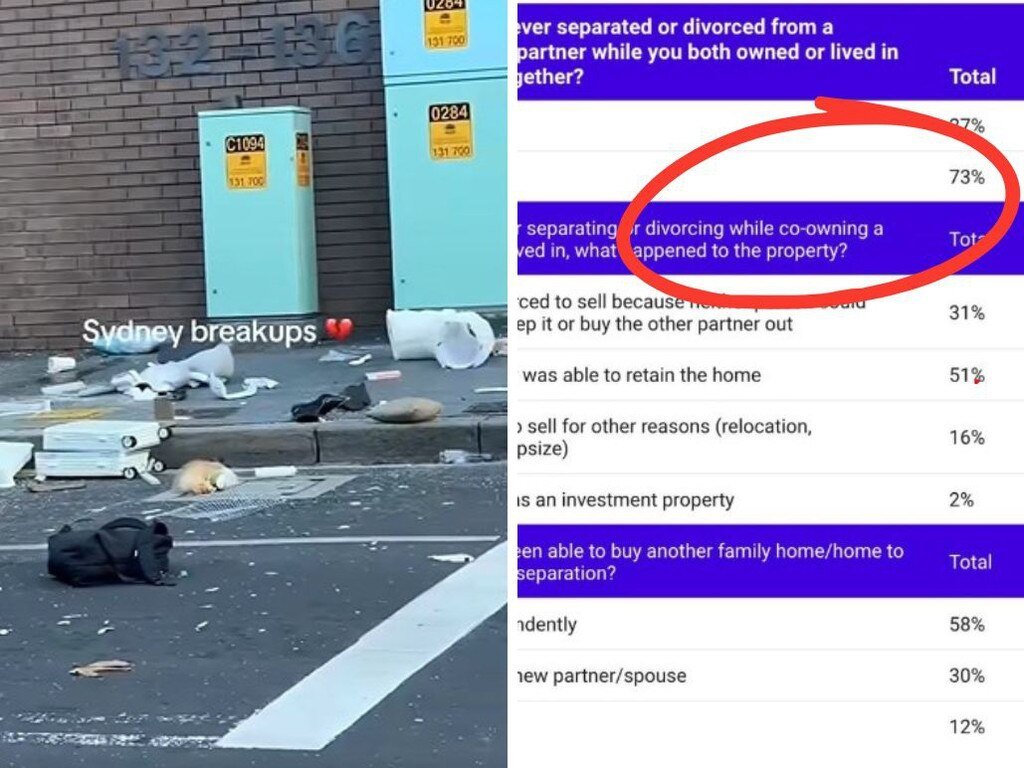
A wild Sydney CBD break-up scene has thrown a harsh spotlight on a growing reality for Australians: many can’t afford to leave their ex, even after the relationship is over.
Footage shared to TikTok this week appeared to show the aftermath of a fiery split at the corner of Sussex and King streets, with household items allegedly hurled from an apartment window and left scattered across the footpath below.
The video, posted by content creator Jackson Murray, showed heaters, a baby stroller, suitcases, bags, pillows and other belongings strewn across the busy city street.
“Just Sydney things,” the caption read.
Commenters were quick to joke about the chaos, while others pointed out how dangerous the scene could have been for passers-by.
“That’s exactly why it’s called a BREAK UP,” one person wrote.
Another said: “It would be funny if it wasn’t so dangerous.”
MORE NEWS
Sad new divorce reality gripping Australia
‘Hell’: Renter’s landlord text exposes sad act
‘I have nothing left’: Owner’s $64k strata ordeal
A heated Sydney CBD scene has put a spotlight on the brutal financial reality of modern breakups. Source: @jieksun/TikTok
But behind the viral moment is a much uglier financial truth.
New research shows a growing number of separated Australians are trapped living with former partners because the cost of breaking up has become too high.
According to the Real Insurance Separation Report 2026, nearly one in five separated or divorced Australians still live with an ex because they can’t afford to sell.
Among those forced to stay under the same roof, 42 per cent said the cost of living made it too expensive to move out and live separately.
Queenslanders were the most likely to be stuck living with a former partner, with 48.1 per cent saying separated couples were staying together because they couldn’t afford to live apart.
New South Wales followed on 45.4 per cent, then South Australia and the Northern Territory on 44.4 per cent, Victoria and Tasmania on 42.4 per cent, and Western Australia on 17.1 per cent.

Separate research from Money.com.au found 27 per cent of Australians have gone through a divorce or separation while jointly owning a home.
Of those, only 51 per cent said one person was able to keep the property.
Nearly a third, 31 per cent, were forced to sell because neither side could afford to keep the home or buy out the other.
Another 16 per cent sold for other reasons, including downsizing or relocating, while just 2 per cent held onto the property as an investment.
Money.com.au mortgage expert Nick Burgess said many Australians underestimate how quickly separation can trigger financial collapse.
“A separation reduces a household’s financial capacity. Going from two incomes supporting a mortgage on the family home to a single income can quickly create a financial shock that sets people back years,” he said.
“Many people either don’t have enough borrowing power to buy out their former partner, or they can’t service the mortgage repayments on the family home on their own.”
For many, the family home becomes the biggest casualty.

Australians are finding divorce so expensive they can’t afford to move out, with many separated couples forced to keep living under the same roof because selling up or starting again is simply out of reach.
Burgess said couples often have no choice but to sell, split the equity and then try to re-enter a market that is even harder for single buyers.
“They’re forced to sell and split the equity, which often leaves both parties with smaller deposits for their next purchase and the challenge of buying back into a market where prices continue to rise and borrowing as a single applicant is significantly harder,” he said.
“In fact, many solo buyers don’t meet bank serviceability requirements at today’s property prices.”
The research found 58 per cent were eventually able to buy another home independently after separating, while 30 per cent returned to the market with a new partner.
But 12 per cent said they had not been able to buy again at all.
The financial pain also starts well before anyone moves out.
The Real Insurance report found 39 per cent of respondents said money pressure significantly delayed their decision to separate.
Women were more likely to be affected, with 46 per cent saying financial worries held them back. Younger Australians were hit even harder, including 77 per cent of Gen Z and 61 per cent of Gen Y.
About 40 per cent said they felt financially dependent on their partner before separating, including 54 per cent of women compared with 27 per cent of men.
Hitch principal lawyer Elise Fordham said women were often the hardest hit.
“For women who have stepped back from their careers to raise children or support a partner’s professional life, separation can be a financial free fall,” she said.
“Overnight, they can lose access to income, joint accounts, and the family home, often with no independent financial footing to fall back on.”