

Blockchain data company Bitquery’s latest analysis, with figures verified Oct. 26, found that similar shares of new Pump.fun coins received an outside buy within roughly 1.3 seconds across Solana’s earlier block-time cuts. Detected sandwich patterns also persisted in the sampled trading.
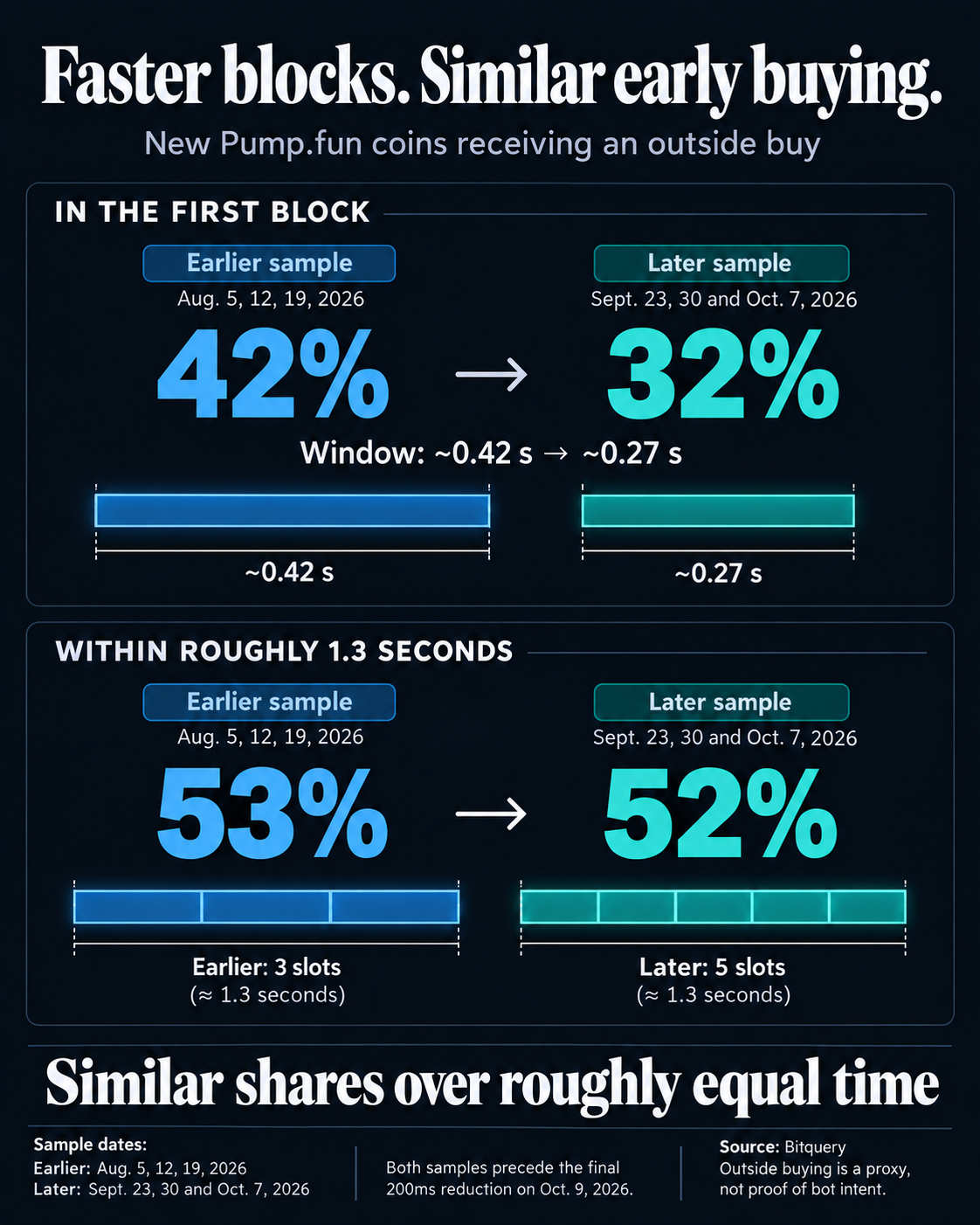
The share was about 53% in the earlier sample, compared with 52% later. An outside wallet means any wallet other than the coin’s first buyer. The comparison used Aug. 5, 12, and 19 against Sept. 23 and 30 and Oct. 7.
Both comparisons end Oct. 7. Solana’s rollout record places the final reduction to a 200-millisecond slot target on Oct. 9, leaving that last step outside the trading observations.
Sniping means racing to buy a token in its first moments. Bitquery’s outside-buy measure captures early buying without establishing that every qualifying buyer was automated or predatory.
The share of new coins receiving an outside buy in their first block fell from 42% to 32%. But the first block also became shorter, lasting about 0.27 seconds in the later sample against 0.42 seconds earlier. A first-block purchase had a narrower window in which to qualify.
The roughly 1.3-second comparison covered three slots before and five in the later sample. The decline in first-block buying was much less evident when measured over approximately equal elapsed time.
Sandwich patterns dipped, then returned
A sandwich involves buying before another trader’s swap and selling afterward at a price pushed up by that swap. Bitquery reported about 30 detected patterns per 10,000 swaps in early August, 26 during Aug. 22-27, and 21 during Aug. 29-Sept. 17. The rate then reached 33 during Sept. 19-Oct. 7.
The denominator included swaps on Pump.fun and PumpSwap, its exchange. The counts came from daily sandwich detections associated with bot wallets before Bitquery applied its study’s final filters.
The Solana Foundation’s August modeling described competing effects on sandwich profitability. Less time to react can constrain an attacker, but shorter slots can also mean fewer competing trades use up the price movement a user permits before a swap executes.
If that allowance stays the same, a fast attacker may have more room to exploit it, and the model offers possible mechanisms.
The Foundation describes shorter slots as improving latency and narrowing a leader’s control over block building. Bitquery’s sampled trading patterns show why that benefit and protection from predatory trading need separate measurements.