
I am profiling Ebay in this article more as an update to the friends I invest with.
From 2011 till today, which is about 15 years, Ebay’s total return is about 676%.
That is 14.6% p.a.
You might not find that very good but I think if I have $1 million of my money then and I end up with $7.76 mil today I will be pretty happy.
Here is how the share price look like.

Most of you that are from my generation would know Ebay as a platform to bid or auction second hand stuff. At one point they have PayPal in them but decide to spin it off.
In the years followed with so many web 2.0 companies, SAAS companies, Ebay ends up being forgotten.
If you are thinking about buying information technology companies, you want to buy something with good future prospects.
It will be a lot of things but Ebay most probably.
This is how its revenue look:

It is like today’s revenue is lower than 2011.
Here is how its net profit or net income look:

The total income it earns today is less than in 2011.
Not just that, the income is pretty inconsistent as well with about 4 years out of 15 that is either very low or negative net income.
But how does its free cash flow look like:

While net income is inconsistent, the free cash flow is at least positive every year.
Just that the free cash flow is getting lower and lower but it is still there.
The free cash flow yield in 2011 was 13.9% (FCF / Market Cap in Jun 2011).
The free cash flow yield in 2025 was 5.1%.
Ebay only started paying dividends in 2019 starting with a 1.55% dividend yield and currently has a dividend yield of 1.74%.
So what happen?
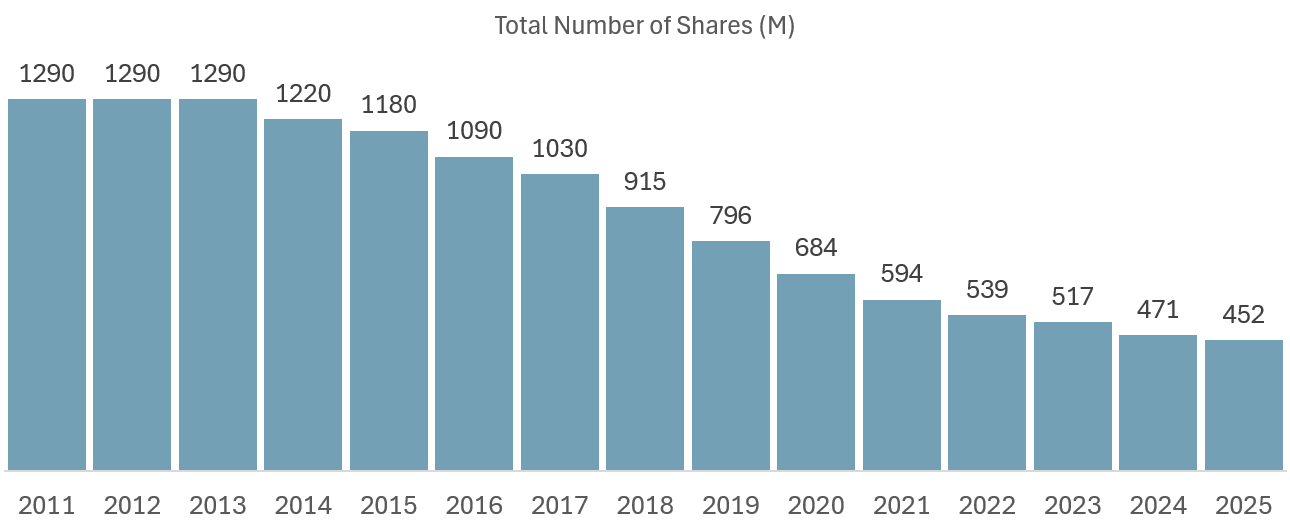
Here is its outstanding share change over the 15 years:

Ebay started reducing their outstanding shares in 2014 and have accelerated the number of shares. They have reduced 65% of their shares in the past 15 years.
Each year they been spending the follow amount to buy back their shares:

They would spend more than their free cash flow on buy back.
Where did that come from? From increasing their debt.
Here is their change from net cash to net debt:

Taking debt to buy back equity feels reckless but only if you find that retiring equity is a higher return than the interest you pay on debt.
Ebay’s current net debt to asset is 8.1%.
In a way, they have a lot of room to utilize debt to buy back more shares if they wish to.
Despite the free cash flow going down, when view with falling outstanding shares, each share is actually getting more free cash flow.

The current free cash flow yield is 4.47%.
If the outstanding shares of a company goes down and earnings per share goes up, by right the market cap should still be roughly the same, if there isn’t a earnings multiple contraction or expansion:

But EBay’s market cap seems higher than where they start off.
Ebay is interesting in that it has all the profile of a business, with revenue and earnings history telling you that can’t get anywhere with it, yet, it turned out to be a 14.6% p.a. compounder.
With a pretty haphazard results, their share price should trade nowhere for the last 15 years.
Yet I think its share buy back with its excess cash flow and cash lead to higher price per share if the price earnings didn’t change much.
Ebay proves a few things:
- Some business can have no revenue and earnings growth.
- But they can have a decent free cash flow that went nowhere.
- And the business was there long enough. Like it went like this for 15 years.
- Buyback is a reward to shareholders just like a dividend. It gives the market a reason to revalue the stock up.
- Yet the most important point, Ebay started off cheap with a high free cash flow yield, or buy back yield (the free cash flow plus cash and debt that can be use for buy back before hitting excessive debt levels)
The difference now is the free cash flow yield have fallen a fair bit such that the current free cash flow yield that can be use for buy back is only 4.45%.
I imagine taking the current $1.75 billion free cash flow, insert as net income in my buy back model calculator (which you can access through here), assume 0% income growth, 100% buy back with all their cash flow:

And I want to see how fast the earnings per share and subsequently share price can appreciate if the earnings multiple is held constant.
The growth is much smaller, purely because at 4.4% buy back yield, our pace of buy back is far slower.
I think about out of all the SAAS companies, how many can have a 15-20 years of free cash flow and be able to survive for that long?
If they cannot stay in business as a listed company for that long, then this equation doesn’t work.
Ironically, we are asking the company it spun off, PayPal that question.
If you want to trade these stocks I mentioned, you can open an account with Interactive Brokers. Interactive Brokers is the leading low-cost and efficient broker I use and trust to invest & trade my holdings in Singapore, the United States, London Stock Exchange and Hong Kong Stock Exchange. They allow you to trade stocks, ETFs, options, futures, forex, bonds and funds worldwide from a single integrated account.
You can read more about my thoughts about Interactive Brokers in this Interactive Brokers Deep Dive Series, starting with how to create & fund your Interactive Brokers account easily.

Kyith is the Owner and Sole Writer behind Investment Moats. Readers tune in to Investment Moats to learn and build stronger, firmer wealth foundations, how to have a Passive investment strategy, know more about investing in REITs and the nuts and bolts of Active Investing.
Readers also follow Kyith to learn how to plan well for Financial Security and Financial Independence.
Kyith worked as an IT operations engineer from 2004 to 2019. Currently, he works as a Senior Solutions Specialist in Fee-only Wealth Advisory Firm Providend. All opinions on Investment Moats are his own and does not represent the views of Providend.
You can view Kyith’s current portfolio here, which uses his Free Google Stock Portfolio Tracker.
His investment broker of choice is Interactive Brokers, which allows him to invest in securities from different exchanges all over the world, at very low commission rates, without custodian fees, near spot currency rates.
You can read more about Kyith here.