
My Telegram chat was discussing about whether there is a role for small cap value in the portfolio.
I think everything depends on your investment philosophy and I can imprint some of mine on you if you don’t have an investment philosophy at all. But if you have, you would need to get educated about it.
Somehow, the discussion turn to small cap usually don’t do so well when entering a recession.
The very prevalent thought is that small caps usually does well (when they say well it means outperformance over another thing which is usually large cap.) when they exit a recession. During the last spurts of the bull market, small cap may also do well.
But aside from that small caps is basically shit.
Well since I have the data, and I have LLMs, I thought I would compile the returns so that we can discuss things.
I took the data from Dimensional ReturnsWeb which would give me Jun 1927 to Feb 2026 data for:
- S&P 500 (US large cap)
- Dimensional US Small Cap Index (US small cap). This is basically a research index that models what if we take a certain methodology and apply it to the universe of securities when the data for the universe of securities is available. This will select the smallest US companies then, but excludes the companies with the lowest profitability and highest relative price within the small cap universe.
- Dimensional US Small Cap Value Index (US small cap value). Same as the previous but instead of largely including all, it only selects the bottom 35% of the US small Cap Index. It is basically a potent version of the one on top
This will allow us to assess the performance during different phase of US recession.
In this post, I profile the 16 US Recession in the past 100 years and you be able to see their start and end, how the markets starts going down and then starts going up.
Not all markets go down when recession starts. They go down much earlier:

But it is common markets go up before recessions officially end.
Let us look at some data
Performance of S&P 500, Dimensional US Small Cap (SC) and Dimensional US Small Cap Value (SCV) months after Recession Officially Starts
The idea of this is suppose you have 90% of your important cash net wealth invested at the start of each recession.
The first table shows the performance 3 months, 6 months and 9 months later.

Firstly in the 3-month and 6-month it kinda sucks. This should be a take away. In great depression it kind of sucks even more.
In some recessions, you cannot tell the magnitude of difference between large cap and small cap value.
There are some years where the performance of US small cap value looks worse:
- 1937 – 1938 Recession in Depression
- 1948 – 1949
- 1953 – 1954
- 1980
- Gulf War
- Covid-19
But there are some years where the US small cap value actually did better:
- Oil Crisis
- Tech Boom and Bust
Now let us take a look at 12-months, 24-months and 36-months later:


Firstly, Great Depression still sucks! Even after 3 years things have not recovered.
Secondly with time, markets tend to recover even after some really hair raising situations.
Lastly, you would notice for almost all after time small cap value did better.
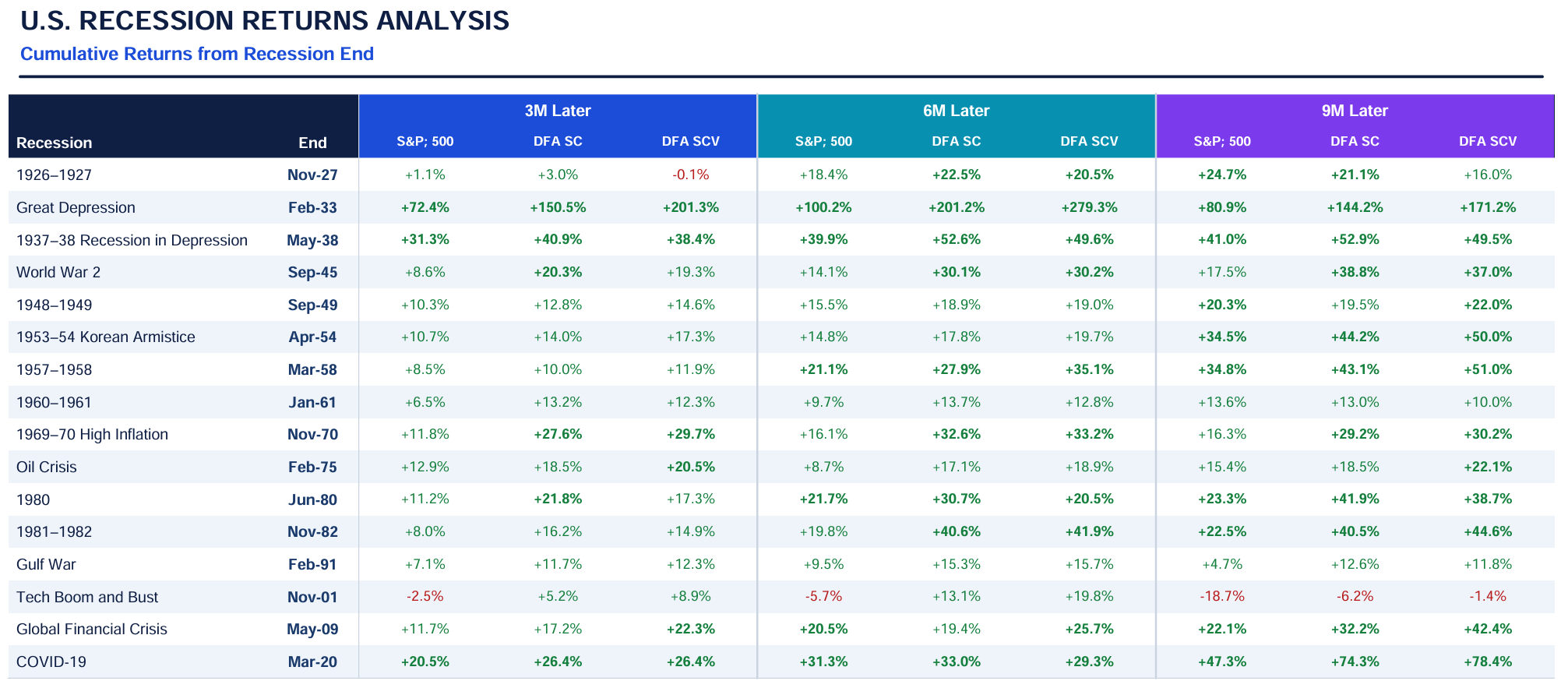
Performance of S&P 500, Dimensional US Small Cap (SC) and Dimensional US Small Cap Value (SCV) months after Recession Officially Ends
Now instead of investing all your money when recession officially starts, you do it when inflation officially ends.

Firstly you realize most of them are green except for the Tech Boom and Bust.
Secondly, small caps tend to do better even in the short term. You can make a case that small caps really do better exiting a recession.
I cannot find any recession where the S&P 500 did better 3 months, 6 months and 9 months later.
Now here are the longer term ones


The tech boom is the unique one where the US large cap actually did far worse than the small caps.
Epilogue – Small Cap Value Underperformance is Too Mixed For US To Make Tactical Decisions
I always look at this as advising some very high net worth who wish to deploy all their money all at once if they should be concern.
Zooming in on the performance data on recession start may address what you are concern with because it puts you in a frame of mind that you didn’t do anything entering a recession.
I think one conclusion is that… in the short term things are just going to be rough. 9 months to a year is always a short period. But overtime it gets better.
I stared at the 3 month, 6 month and 9 month data for a while to see if they are genuinely much more shittier. There were some more hairy small cap value ones such as 1969-1970 high inflation 6 months later, Gulf war and Covid-19.
I should remember it can really be shitty.
It is interesting that 12 months later, all these more shitty experience actually normalize out.
This has been a good exercise and its good that I don’t have to crunch the data so much now!
If you wish for the UCITS version, and also a global small cap exposure with systematic value and profitability philosophy you can check out
You can buy them both on Interactive Brokers.
If you want to trade these stocks I mentioned, you can open an account with Interactive Brokers. Interactive Brokers is the leading low-cost and efficient broker I use and trust to invest & trade my holdings in Singapore, the United States, London Stock Exchange and Hong Kong Stock Exchange. They allow you to trade stocks, ETFs, options, futures, forex, bonds and funds worldwide from a single integrated account.
You can read more about my thoughts about Interactive Brokers in this Interactive Brokers Deep Dive Series, starting with how to create & fund your Interactive Brokers account easily.

Kyith is the Owner and Sole Writer behind Investment Moats. Readers tune in to Investment Moats to learn and build stronger, firmer wealth foundations, how to have a Passive investment strategy, know more about investing in REITs and the nuts and bolts of Active Investing.
Readers also follow Kyith to learn how to plan well for Financial Security and Financial Independence.
Kyith worked as an IT operations engineer from 2004 to 2019. Currently, he works as a Senior Solutions Specialist in Fee-only Wealth Advisory Firm Providend. All opinions on Investment Moats are his own and does not represent the views of Providend.
You can view Kyith’s current portfolio here, which uses his Free Google Stock Portfolio Tracker.
His investment broker of choice is Interactive Brokers, which allows him to invest in securities from different exchanges all over the world, at very low commission rates, without custodian fees, near spot currency rates.
You can read more about Kyith here.