
What if I tell you that if you invest in a MSCI World tracking ETF, such as the IWDA using Interactive Brokers, you can get consistent inflation-adjusted 6% p.a. income from the ETF for 30 years and still preserve your capital in inflation-adjusted terms?
And there are good evidence to back that up?
I think have this kind of income yet still preserve the capital is the stuff of dreams.
And it will definitely make your eyes perk up of such an income strategy, based around the Safe Withdrawal Rate (SWR) framework. The SWR income framework is Kyith’s preferred framework for spending down his S$1.65 million Daedalus Income portfolio.
In a way, most are apprehensive about his chosen strategy because:
- They feel the income don’t adjust for inflation.
- If you sell units from say an index tracking fund that does not pay out a natural income distribution, it is only a matter of time before the $1.65 million will go to zero if he keeps selling units.
- A 100% equity portfolio is too volatile.
- There are years of negative returns, and if you spend during those years, the portfolio will not preserve its value.
- Selling units will not preserve the portfolio value.
Over the past few months, I took a leisure pace to built Gilgamesh, which is a personal software to better illustrate these income planning concepts.
Suppose we plan:
- Start with a S$1 million portfolio invested in 100% IWDA, which is an index fund that tracks the MSCI World index. The recurring fee is a high 0.50% p.a. [The actual expense ratio is actually 0.20% p.a. so I am making the portfolio more costly]
- We start with spending $5000 a month or $60,000 a year.
- Every subsequent years we adjust the income based on previous year’s inflation. This would show if the income keeps up with your needs.
- We want the portfolio to last 50 years. Typical retirement is 30 years but since some of you are planning to early retire, let us make it harder.
A success is if:
- You get an inflation adjusted income for 50 years.
- The S$1 million is preserved. This means that S$1 million is adjusted for inflation as well for your beneficiaries.
So here it is:

This chart above shows how the monthly income that you will get progress from a starting of $5,000 monthly till the end of 50 years. The time-scale is in months so if you see 599 months that is the end of 50 years.
You can see that the $5,000 monthly income grew to $30,612 monthly income after 50 years.
The inflation over this 50 years is 3.69% p.a. This inflation rate is even higher than a lot of the 3% p.a. inflation planning advisers like to use.
Now how is the S$1 million portfolio capital after this spending?
Here it is:

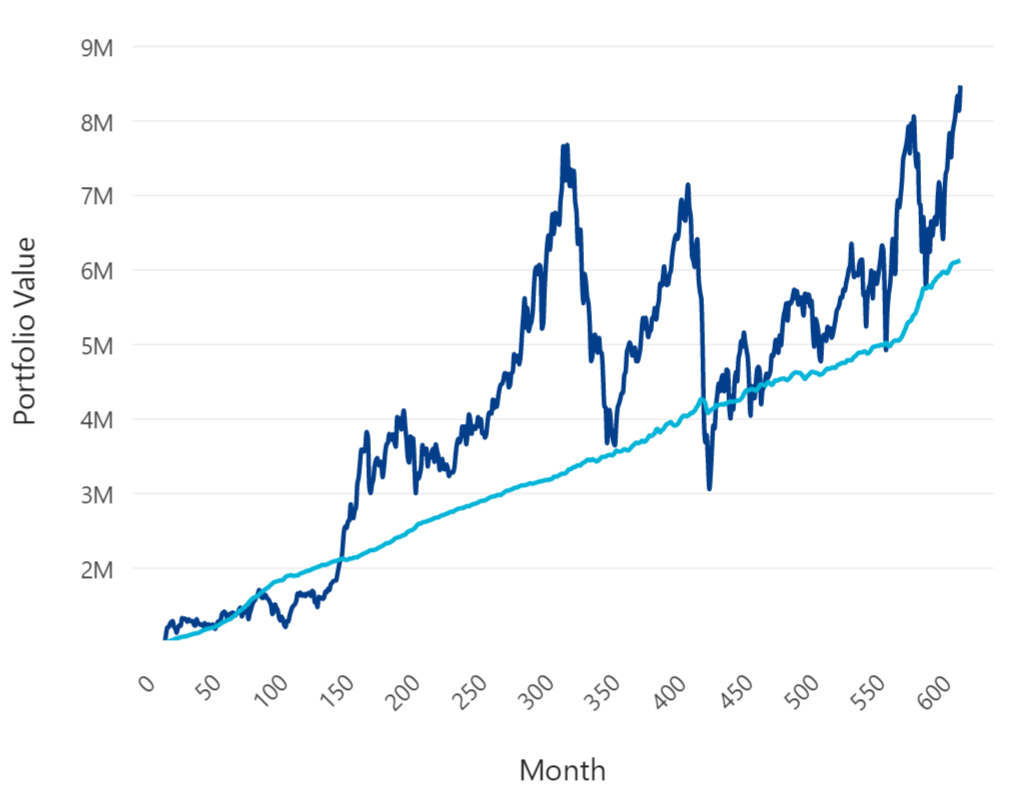
This chart shows the portfolio value, after providing that income stream we discuss previously. The dark blue line shows the portfolio value.
S$1 million eventually end up as S$8.1 million.
How do we know that the portfolio value is preserved?
The lighter blue line (should be cyan) shows the value of S$1 million portfolio adjusted by inflation.
If the dark blue line is above the light blue line at the end, the portfolio value is preserved. If it is below, the portfolio value is not preserve.
The ending value of the light blue line is S$6.1 million which is lower than S$8.1 million. This means the portfolio value is preserved.
So a retiree would enjoy $5k of income growing to $30k, and still have S$8.1 mil after 50 years which is higher than inflation. Their beneficiary can take over the portfolio for it to go on further.
But Kyith Why Then do You Keep Saying Based on the SWR Income Framework, we can only spend a starting 2-4% of the S$1 million Amount? Why can we spend like 6% now?
Good question.
Now since I can simulate, let me do the same thing, but lets look at all the 50-year retirements using the data from 1970 till Jun 2025. If we go from Jan 1970 to Dec 2019, then Feb 1970 to Jan 2020, then Mar 1970 to Feb 2020, and so on… we can see in many parallel universe, Kyith will have inflation adjusted income and still preserve the portfolio value.
The outcome is shown in this chart here:

Kyith what is this 7.4% that I am seeing?
From Jan 1970 to Jun 2025, there are 68 50-year periods.
If we run the same thing, only 5 out of the 68 50-year periods, Kyith have income and Kyith’s portfolio is above zero.
Almost 63 30-year period, Kyith’s S$1 million portfolio ran out of money prematurely.
Maybe let me show you one of them:

In this one 50-year instance, the S$1 million portfolio finish in 150 months or 12.5 years.

The $5,000 monthly income increased to $12,007 monthly income in 12.5 years before the portfolio is exhausted.
Why did this idiot Kyith extract soooooooooo much income from the portfolio?
Well we got to blame it on inflation because inflation caused the income need to doubled in almost 12 short years.
Gruesome.
Kyith… This Kind of Income Strategy is Not Sustainable Lah…..
You are right. It is not sustainable.
But I did show you an attractive, consistent, inflation-adjusted income right?
I showed you one very long 50-year period where it works.
Do you care about the other 50-year periods that doesn’t work? Isn’t 5 out of 68 good enough?
Kyith, I Think I Stick With More Reliable Income Strategies like a Dividend Income Strategy That Should Give Me The Same Inflation-adjusted Income While it Preserve My Capital Value.
You are free to choose a better income strategy.
But if staying retired, not working, and having income to provide for your family is important to you, then I really hope what you have chosen is a more robust strategy.
Let me give you some handles.
To provide income for your family’s spending, especially if your spending is pretty inflexible, your income strategy needs to satisfy ALL the following criteria:
- It needs to be consistent enough. If you need $5,000 monthly the strategy must give you $5,000 monthly preferably more but cannot be less.
- If your spending needs this year is 5% higher, instead of 3%, this income strategy would need to provide for it. There can be inflation sequence such as 10% in the first year, then 4%, before lowering down to 1% then 2%. Your income strategy should be able to step up. Remember that 50-year sequence where the $5,000 monthly income needed to increase to $12,007 monthly in 12.5 years? Your income strategy needs to do the same thing.
- You need to make sure the income last for the tenure. In my example above 50 years.
- And the capital value needs to be preserved.
Actually, I just reiterated what I have tested with the MSCI World SWR strategy.
Why Must We Satisfy All Those Income Criterias?
This is because that is what you need.
Time and again we are reminded that this is the income wish because if we have this, and we meet the requirements, then we can be financially independent and retire early.
Some of you can choose to work part-time, or that you feel you can be more flexible with your spending.
That is fair and very anti-fragile mindset.
But:
- Would you want to work at 83 years old if your portfolio is running low and could you find employment?
- How much could you adjust? Would the adjustment save your portfolio?
I Ran 68 50-year Simulations with Actual Historical Returns to Tell You the Survival Rates with a 6% SWR Income Strategy are Slim.
If you have a better strategy, you should ask if that strategy will work for 1 50-year period let alone 68 50-year period.
Many of the local investment experience is just… 20 years, maybe 25 years or less, not even one 50-year period.
Spending based on a 6% dividend yield have worked for 20 years but would it work if it continues?
To make sure that your income strategy, is robust, you can take my blueprint and run it through 68 times.
Your challenge may be that… these companies that work well in the dividend strategy may not even have that long of a history for you to simulate 68 50-year periods.
You might need to feel again the reliability.
The Same Rigors of the SWR Framework Can Tell You a More Starting Conservative Income.
The same framework that show you weakness can also show where the line of conservatism is.
William Bengen’s Safe Withdrawal Rate is a framework, one where many of us have benefited from, and in a way with historical market data, and inflation data, we can build our own tools to evaluate the robustness of the income strategy.
I crafted Gilgamesh to be able to view the SWR in various angles.
Gilgamesh can see the highest income that you can spend from a 100% MSCI World Equity portfolio with 0.50% p.a. cost for different income tenure:

This table shows the different income tenures and the corresponding highest SWR.
So if the income tenure is 33 years, and the highest SWR is 3.6%, it means if you wish to have inflation-adjusted income for all the 33 years between 1970 to 2025, the highest you can spend in the first year is $36,000 on a $1 million portfolio.
And Gilgamesh can test this:

We can see that out of 372 33-year period, all of them ended the 33 years positive.
You CAN Preserve Capital By Selling Units from an Accumulating Fund.
Having a perpetual income fund to be able to past to the next generation is what many wish. And is the most common push back against selling units.
The crux of preserving capital is not about only spending income but making sure you respect the SWR.
Continuing with the 33-year SWR example, we know that if we respect the 3.1% SWR, all the past 272 33-year periods end positive.
But do they preserve value?

Here are all the 272 33-year period play by play over their 33-year history. If you have a more robust income strategy, you need to view them in these threads and ask yourself do all the threads end up all sloping up. If the thread is green, the capital value is preserved in those 33-years. If it is red, they end with $0. You can’t really see the grey lines, which are the cases where the capital value is not preserved.
Let me break it out:

26 out of the 272 successful 33-year periods did not preserve the income and you can see how they look like.
Notice that they are all upward sloping.
I think many fear that if you adopt this strategy, your portfolio won’t grow.
These are the most pessimistic 33-year periods, and as you can see the minimum grows to $2.1 million.
Epilogue.
I find myself describe more and more that you can have a better income experience with a SWR Framework than a 6% dividend yielding portfolio.
It is just that… not all the periods could survive.
I could also describe the strategy having a 6% yield income potential but I choose to start my income spending at half that of 3%.
You realize it is a matter of framing.
I would also say most income strategies moves closer to a SWR framework, even if the person describes it in the weirdest way.
They will select dividend income stocks that averages 5% in dividend yield.
But they will only feel safe enough to retire if they have a 100% buffer, which means their spending is only 2.5% of the portfolio.
Now you tell me what is the difference between the capital needed based on a 2.5% dividend yield, and a 2.5% SWR framework?
No diff right?
What made an income strategy work may not be its natural dividend yield.
If the safety comes from the natural dividend yield, the investor would have relied on the portfolio once it reaches 5% in dividend yield, with far less capital.
But deep down, the aspiring retiree knew that just meeting 5% in dividend income yield is not safe enough. They would buffer it with X number of years in cash.
The SWR framework suffers from a marketing crisis. It is not so easy to understand.
The income strategies of today, be it cash cushion, bucketing strategies lacked rigor the way we can craft tools to validate variations of Bengen’s original strategy.
That rigor actually help optically easier to understand income strategies like a dividend strategy because it shows that they can have the same robustness as the SWR strategy.
Hope you find this cheeky article useful in some ways.
Time to fly.
If you want to trade these stocks I mentioned, you can open an account with Interactive Brokers. Interactive Brokers is the leading low-cost and efficient broker I use and trust to invest & trade my holdings in Singapore, the United States, London Stock Exchange and Hong Kong Stock Exchange. They allow you to trade stocks, ETFs, options, futures, forex, bonds and funds worldwide from a single integrated account.
You can read more about my thoughts about Interactive Brokers in this Interactive Brokers Deep Dive Series, starting with how to create & fund your Interactive Brokers account easily.

Kyith is the Owner and Sole Writer behind Investment Moats. Readers tune in to Investment Moats to learn and build stronger, firmer wealth foundations, how to have a Passive investment strategy, know more about investing in REITs and the nuts and bolts of Active Investing.
Readers also follow Kyith to learn how to plan well for Financial Security and Financial Independence.
Kyith worked as an IT operations engineer from 2004 to 2019. Currently, he works as a Senior Solutions Specialist in Insurance Start-up Havend. All opinions on Investment Moats are his own and does not represent the views of Providend.
You can view Kyith’s current portfolio here, which uses his Free Google Stock Portfolio Tracker.
His investment broker of choice is Interactive Brokers, which allows him to invest in securities from different exchanges all over the world, at very low commission rates, without custodian fees, near spot currency rates.
You can read more about Kyith here.