
I came across this article which explains that the best performing income ETFs of 2025 happens to be convertible bond strategies and emerging market local currency funds.
The best performing bond ETFs of 2025.
Convertible bond funds is interesting when consider as income ETFs because they yield so little relative to other fixed income by their usual nature.

Convertible bonds are like call options on equity. If their equity eventually do well, the convertible bonds also rose in value. It is understandable they may do better in a good equity environment.
Therefore, like high yield bonds, I would say that they are more equity-like, which means you are taking on equity risks in a certain manner. The good thing is in the event the equity returns are poor, you get back you principal plus low coupon returns, provided the convertible bonds don’t default.
When I see convertible bonds, I was reminded of the breakdown of Allianz Income and Growth fund that I wrote because the fund is made up of:
- 33% US Equity
- 33% US High Yield Bond
- 33% US Convertible Bond
I get comments seemingly from agents, bank representative on the lines that I don’t know what I am talking about, that this is a don’t know how many billion dollar fund and I should stay in my own lane.
Well I wrote the article in May 2023 so lets take a look at its 2023, 2024 and also YTD returns up to end 2025. I will be more focused on USD returns so I am referencing their AM USD Dis, AMg2 USD Dis share class more due to the currency but also cheaper fee (at 1.50% p.a.)
Most people were enticed into Allianz Income and Growth due to its income but income is also part of the return. My friend told me they actually write/sell options to boost the income yield and that should be part of total returns you see.
Per Allianz site here are the Allianz Income and Growth total returns:
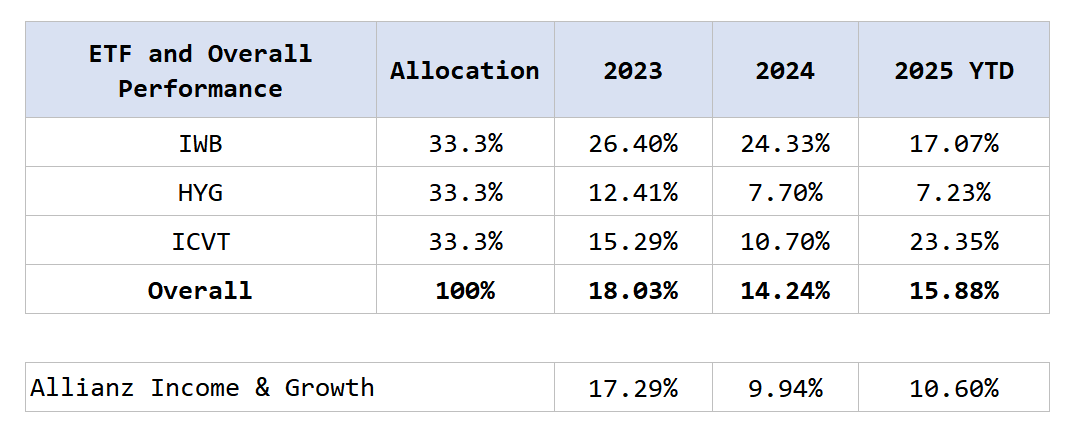
- 2023: 17.29%
- 2024: 9.94%
- 2025 (end Oct): 10.60%
I want to see if the fund composition is still very much 33.3% in all three:

I think it is still about there although they have fair bit more cash.
Since the fund is actively managed and owns almost 33% each of those we can just reference if they did better than a portfolio made up of the following index ETFs:
| Index | ETF |
| Russell 1000 Index for US Equity | iShares Russell 1000 ETF (IWB) |
| Markit iBoxx USD Liquid High YIeld Index | iShares iBoxx $ High Yield Corporate Bond ETF (HYG) |
| Bloomberg US Convertible Cash Pay Bond > $250MM Index | iShares Convertible Bond ETF (ICVT) |
Here is the performance over those time frames that I mentioned:

They continue the performance in my last article by being below a composite portfolio like this.
I suppose you could make an argument that it is easier for you to invest in one fund and you cannot invest in these 3 ETFs in your SRS account.
Well, i think people overrate the performance, if we put them through the right lens.
I have also updated the income distribution table in my previous article:

They have maintained their payout since May 2023 which is my last update.
If you buy the AM USD class today, the prevailing Income distribution is 7.75%.
I always think it is odd that people will push back on me with a income strategy based on the Safe Withdrawal Rate Framework (SWR) because:
- The natural income distribution of a broadly diversified portfolio is lower than usual.
- They don’t like selling units. It is like your capital will be gone.
But you are pretty okay with something with a natural yield that might be lower.
Here is the 12 month trailing yield of the underlying:
- IWB: 0.97%
- HYG: 5.76%
- ICVT: 1.75%
- Yield if it is a composite portfolio: 2.8%
You are perfectly okay with something with a natural income distribution of 2.8% to pay something like 7.75% and not asked questions how that is sustainable.
If you would like to find out how much Allianz pay out your distribution from its natural distribution and from selling the capital, you can go Google “Allianz SG Dividend Composition” and you should get this Fund Literature page. And you can find this document Fund Dividend Composition.

You can see that the AM USD, AMg2 USD has an underlying portfolio yield of 2-3% which shows that I am not too far off.
Just to help you not take a look at what the column means here are the expanded explanation:
- Distributable Income: Interest + dividend income + net realized gains a fund receives from its portfolio payable to you net of fees and expenses.
- Capital:
- Net unrealized gains (gains – losses)
- Net distributable income accrued as at the end of financial year BUT is NOT DECLARED and paid as dividends at next distribution date immediately
- Underlying portfolio yield: an annualized version of #1 divide by unit price
- Average payout yield: Simple average yield of annual dividend yield paid to shareholders since inception or past 10 years.
For the last 12 months, on average Allianz Income and Growth Class AM USD Dis pays out 61% from capital and 39% from income.
I sometimes die laughing when I reflected and think how investors try so hard avoiding to sell units to get income thinking it is risky but would eventually end up in something like an Allianz Income and Growth.
Let me be clear: It is not the fault of the manager.
In a way, they crafted this, with such distribution because you like it. If you don’t like it, you won’t fund Allianz Income and Growth to 55.8 Billion. To be fair not all share classes pay out like this.
In the SWR framework, I showed empirical evidence that it doesn’t mean if you sell your securities to take gains, instead of the natural dividend and interest income, your fund/portfolio will run out of money prematurely.
It is:
- How much you start withdrawing relative to your portfolio value.
- How sound is the systematic strategy you wrap around your investment to step up when markets are good and step down when markets are poor, relative to your portfolio value.
So getting income from capital is not taboo.
But you got to wonder: How much does the manager know about your individual income needs and how you feel.
Zero.
And so the fund manager is providing a generic distribution based on their own mandate/systematic strategy. What that is I don’t know. If you own it, perhaps it makes sense to find out.
But yeah convertible bonds did pretty well not just this year but past two years. While the fund did not do better than a composite portfolio you can easily put together with lower cost, let’s not forget that returns were good to keep the income humming along.
If you want to trade these stocks I mentioned, you can open an account with Interactive Brokers. Interactive Brokers is the leading low-cost and efficient broker I use and trust to invest & trade my holdings in Singapore, the United States, London Stock Exchange and Hong Kong Stock Exchange. They allow you to trade stocks, ETFs, options, futures, forex, bonds and funds worldwide from a single integrated account.
You can read more about my thoughts about Interactive Brokers in this Interactive Brokers Deep Dive Series, starting with how to create & fund your Interactive Brokers account easily.

Kyith is the Owner and Sole Writer behind Investment Moats. Readers tune in to Investment Moats to learn and build stronger, firmer wealth foundations, how to have a Passive investment strategy, know more about investing in REITs and the nuts and bolts of Active Investing.
Readers also follow Kyith to learn how to plan well for Financial Security and Financial Independence.
Kyith worked as an IT operations engineer from 2004 to 2019. Currently, he works as a Senior Solutions Specialist in Insurance Start-up Havend. All opinions on Investment Moats are his own and does not represent the views of Providend.
You can view Kyith’s current portfolio here, which uses his Free Google Stock Portfolio Tracker.
His investment broker of choice is Interactive Brokers, which allows him to invest in securities from different exchanges all over the world, at very low commission rates, without custodian fees, near spot currency rates.
You can read more about Kyith here.