
In my last post about How the Hedged Class of a Japan Fund Result in a 500% Outperformance Over a Non-Hedge One, I was able to figure out the difference for such a big performance difference of the WisdomTree fund to the ETF methodology, Yen weakening.
But there is still something missing.
A reader manage to point out to me, which triggered me to realize what an idiot I am.
You can Benefit from Interest Rate, aside from Winning with Currency
A significant part of the return is also that during the period, either the WisdomTree Japan Hedged Equity ETF (DXJ) or iShares Currency Hedged MSCI Japan ETF (HEWJ) earns a higher carry relative to before the interest rate rise of 2021/2022.
Many people talk about the Yen carry trade, which is to borrow the Yen and invest elsewhere. Because the Yen interest rate is low, if you borrow the Yen and buy the USD, you earn the interest rate differential.
When both DXJ and HEWJ hedge to the USD, technically, the funds sell 1-month JPY/USD FX Forward contracts. I hate these currency stuff but maybe let me take it a bit slow.
A currency forward is a contract to exchange one currency for another at a pre-agreed rate on a future date. It locks in the exchange rate today, eliminating uncertainty from future rate movements. If you sell a 1-month JPY/USD forward, you agree to buy JPY back to USD in a month’s time. This locks in the exchange rate, so even if JPY depreciates vs USD, DXJ or HEWJ’s USD value is protected.
The JPY/USD forward rate is higher than the spot, or current rate here. This is call a forward premium in JPY (or forward discount in USD), and this is driven by the interest rate differential between Japan and the US.
And this interest rate differential is where the problem lies.
During this 1 month, you are holding USD and later selling the USD to convert to JPY (in hedging they just focus on the premium and discount as either gains and losses). So you are earning money based on US interest rates and indirectly borrowing in Japan interest rates.
By right, if the Yen weakens, based on interest rate parity rules, the interest rates of Japan should be higher. But this isn’t the case.
Now I listed out in a table the US Govt 3-month interest rates, the Japan Govt 3-month interest rates and the difference below:
| US Govt 3-Month Interest Rates | Japan Govt 3-Month Interest Rates | US Rate – Japan Rate (What you will earn if you stay hedged to USD relative to Yen) | |
| Jun 2018 | 1.9% | -0.13% | 2.03% |
| Jun 2019 | 2.3% | -0.15% | 2.45% |
| Jun 2020 | 0.14% | -0.13% | 0.27% |
| Jan 2021 | 0.08% | -0.10% | 0.18% |
| Apr 2021 | 0.02% | -0.09% | 0.11% |
| Jul 2021 | 0.05% | -0.09% | 0.14% |
| Oct 2021 | 0.04% | -0.10% | 0.14% |
| Jan 2022 | 0.07% | -0.10% | 0.17% |
| Apr 2022 | 0.52% | -0.08% | 0.60% |
| Jul 2022 | 1.7% | -0.12% | 1.82% |
| Oct 2022 | 3.2% | -0.28% | 3.48% |
| Jan 2023 | 4.4% | -0.17% | 4.57% |
| Apr 2023 | 4.8% | -0.14% | 4.92% |
| Jul 2023 | 5.3% | -0.13% | 5.43% |
| Oct 2023 | 5.49% | -0.30% | 5.79% |
| Jan 2024 | 5.38% | -0.21% | 5.59% |
| Apr 2024 | 5.36% | -0.05% | 5.41% |
| Jul 2024 | 5.37% | 0.02% | 5.35% |
| Oct 2024 | 4.62% | 0.04% | 4.58% |
| Jan 2025 | 4.32% | 0.21% | 4.10% |
| Apr 2025 | 4.31% | 0.38% | 3.93% |
| Jul 2025 | 4.34% | 0.43% | 3.91% |
| Oct 2025 | 3.94% | 0.45% | 3.49% |
| Jan 2026 | 3.62% | 0.58% | 3.04% |
I only do one specific date for 2018, 2019 and 2020 but I did it quarterly for 2022 to 2026.
What you will notice is that if you constantly hedge to USD, or sell JPY/USD forwards, you earn 2% in 2018-2019, you earn very low from Jun 2020 to Apr 2022, then you earn a fat interest from Apr 2022 onwards.
The Difference in Performance between HEWJ and EWJ, aside from Currency Depreciation, is Close to the Interest Rate Difference.
This is because US interest rates shot up, but Japanese interest rates also shot up, but their shooting up means going from negative to slightly positive!
Now I want to focus on the HEWJ versus EWJ because the underlying basket of equities is similar and the difference is HEWJ is hedged to USD while EWJ is not.
I tabulated the returns of HEWJ over EWJ, the Yen depreciation and the difference between these two:
| Period | HEWJ over EWJ Returns | JPY Depreciation (negative means Appreciation) | Difference |
| 2018 | -0.9% | -2.75% | 1.9% |
| 2019 | 2.0% | -0.4% | 2.4% |
| 2020 | -5.8% | -5.1% | 0.7% |
| 2021 | 11.5% | 10.4% | 1.1% |
| 2022 | 14.0% | 12.0% | 2.0% |
| 2023 | 16.0% | 7.2% | 8.8% |
| 2024 | 17.0% | 9.5% | 7.5% |
| 2025 | 5.2% | -0.4% | 5.6% |
You would notice that the difference coincide with the interest rate differential. It is just that after 2022, what HEWJ earns is 2% higher than the 3-month rate that I tabulated previously.
Fxxk they are doing some magic there.
So basically DXJ won by making 4 bets:
- Japanese equity will do well.
- Countries that export more will do better than a general group of Japanese equity.
- Japanese Yen will weaken.
- US interest rates higher than Japan interest rates rather than the other way round.
Where I Got it Wrong
I was aware of the interest rate differential.
But when I look at it, I just assume interest is the cost for hedging.
It is only when I dive deeper into the fundamentals (a fxxked up process) that I realize fxxk I got the direction totally wrong.
But this was totally worth it (Thanks Desmond) because what is important is to advance my framing of these things. After writing this I am clearer but its still a challenge for my 45/46 year old brain.
Hedging itself is a bet.
It is a bet that USD is stronger than the Yen long term. If you don’t think so you don’t hedge.
When you choose not to hedge, you are not taking a neutral stance. You are making an active decision to hold currency exposure. The absence of a hedge is itself a bet — just an implicit one rather than an explicit one.
Practitioners frame it this way:
Hedging = paying to remove a risk you don’t want to own. Not hedging = choosing to own that risk, whether you meant to or not.
Don’t Expect the Same Thing If You Hedge USD back to SGD
Some of you may be worried that long term the USD is going to depreciate against the SGD.
And it make sense to hedge to SGD if you invest in a MSCI World, or All Country World index tracking ETF.
Well again, if you hedge, you are betting SGD to do well against most currency or that you don’t really wish to stay neutral.
But when it comes to the USD and SGD, the interest rate parity is in play so you might not get the same effect.
Now let’s take it step by step:
During the period of 2000 to 2010, when the S&P 500 did not do well, the USD also go to shit. So if you are a Singapore investor you suffer doubly.

I plotted the USD depreciation against the SGD since I have the data for each calendar year.
You can see that till 2011, there is a constant USD depreciation.
I am sure this is something that many don’t wish to suffer from.
But I got to ask you: Suppose you are in 2011, and after seeing the USD depreciate almost 10 years every single year, would you be able to pull off the hedge because after that, the USD did stabilize.
Well now people keep thinking that from this point we are going to return to those 2000 – 2012 situation.
Hopefully because I also want my US small caps and mid caps to do well! Sorry I digressed.
If you choose a fund that is hedged to SGD:
- The fund Sell a USD forward / Buy SGD forward. Agree to buy back in SGD next time.
- Indirectly borrowing in US interest rates forgoing the Singapore interest rates that you can earn.
To profit like the DXJ or EWJ situation from interest rates, you need Singapore interest rates to do so much better than US interest rates.
Here is the chart showing the Singapore interest rate minus the US interest rate:

You would notice that its more negative than positive.
This means that instead of earning there is a borrowing cost.
Interest rate parity is the principle that the forward exchange rate between two currencies must reflect their interest rate differential — otherwise a riskless arbitrage profit would exist.
Take today’s environment where USD 1-year rates are around 4.5% and SGD rates are around 2.75%: if spot USD/SGD is 1.2712, the 1-year forward must be priced at roughly 1.2508 (USD trading cheaper forward) — because if it weren’t, a trader could borrow in SGD at 2.75%, convert to USD at spot, earn 4.5% for a year, then lock in the forward to convert back to SGD, and pocket a riskless spread. The market closes that arbitrage window immediately by pricing the forward such that both paths — simply depositing in SGD, or converting to USD, earning the higher rate, and hedging back via forward — produce exactly the same SGD return.
This is why an SGD-based fund hedging USD assets back to SGD currently pays a cost of around 1.5–1.7% per year: the forward USD/SGD is set below spot by precisely that amount, reflecting the fact that USD yields more than SGD, and the hedge mechanically gives that yield advantage back to the counterparty.
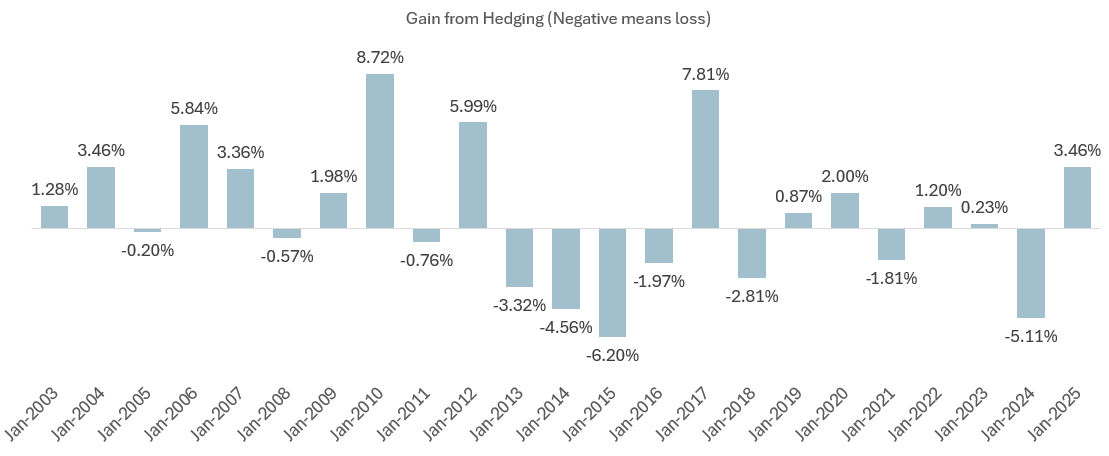
So net of the costs, how given the depreciation of the USD, how much roughly will we gain by hedging over the past 20 years?

The currency hedging will still make you gain 25% or 2.5% p.a. over the first 9 years.
But if we view it over the full 23 years, the gain by hedging is 18% or 0.74% p.a.
You can see the data in a table below:
| Singapore Govt 3-Month Interest Rate | US Govt 3-Month Interest Rate | SG Rate – US Rate (What you will earn if you stay hedged to SGD relative to USD) | USD Depreciation (for calendar year) (Negative means Appreciation) | Gain from Hedging (Negative means loss) | |
| Jun 2002 | 0.80% | 1.71% | -1.04% | ||
| Jun 2003 | 0.53% | 1.09% | -0.56% | 1.84% | 1.28% |
| Jun 2004 | 0.74% | 1.06% | -0.32% | 3.78% | 3.46% |
| Jun 2005 | 1.99% | 2.91% | -0.92% | 0.72% | -0.20% |
| Jun 2006 | 2.80% | 4.71% | -1.91% | 7.75% | 5.84% |
| Jun 2007 | 1.91% | 4.66% | -2.75% | 6.11% | 3.36% |
| Jun 2008 | 0.87% | 1.85% | -0.98% | 0.41% | -0.57% |
| Jun 2009 | 0.20% | 0.14% | 0.06% | 1.92% | 1.98% |
| Jun 2010 | 0.30% | 0.16% | 0.14% | 8.58% | 8.72% |
| Jun 2011 | 0.33% | 0.05% | 0.28% | -1.04% | -0.76% |
| Jun 2012 | 0.29% | 0.07% | 0.22% | 5.77% | 5.99% |
| Jun 2013 | 0.23% | 0.03% | 0.20% | -3.52% | -3.32% |
| Jun 2014 | 0.34% | 0.04% | 0.30% | -4.86% | -4.56% |
| Jun 2015 | 0.88% | 0.01% | 0.87% | -7.07% | -6.20% |
| Jun 2016 | 0.69% | 0.30% | 0.39% | -2.36% | -1.97% |
| Jun 2017 | 0.90% | 0.98% | -0.08% | 7.9% | 7.81% |
| Jun 2018 | 1.55% | 1.91% | -0.36% | -2.45% | -2.81% |
| Jun 2019 | 1.98% | 2.34% | -0.36% | 1.23% | 0.87% |
| Jun 2020 | 0.25% | 0.14% | 0.11% | 1.89% | 2.00% |
| Jun 2021 | 0.30% | 0.02% | 0.28% | -2.09% | -1.81% |
| Jun 2022 | 1.64% | 1.14% | 0.50% | 0.70% | 1.20% |
| Jun 2023 | 4.05% | 5.40% | -1.35% | 1.58% | 0.23% |
| Jun 2024 | 3.85% | 5.39% | -1.54% | -3.57% | -5.11% |
| Jun 2025 | 2.20% | 4.34% | -2.14% | 5.60% | 3.46% |
Learning from the MSCI World Index Hedge to EURO Example.
While we don’t have a Singapore example (I will try if I am not so lazy), there is XDWD which is an Xtrackers MSCI World UCITS ETF (dark blue below). XDWD is unhedged.
Then there is the iShares MSCI World EUR Hedged UCITS ETF or IWDE (pink below).
Imagine that your home currency is in EUR and you are afraid of USD depreciation so you choose IWDE, or the hedge one.
You invest at the start in Aug 2014 and this is the result:

Over the past 11 years or so, XDWD would have gain 262% when view in EUR and the IWDE would have gain only 172%. The EUR actually depreciated 14% versus the USD.
Your currency bet lost. So did your hedged to EUR.
But still you make 9.3% p.a. on IWDE in EUR terms! (XDWD made 12.1% p.a.)
At the end of the day, there is always some uncertainty.
If you want to trade these stocks I mentioned, you can open an account with Interactive Brokers. Interactive Brokers is the leading low-cost and efficient broker I use and trust to invest & trade my holdings in Singapore, the United States, London Stock Exchange and Hong Kong Stock Exchange. They allow you to trade stocks, ETFs, options, futures, forex, bonds and funds worldwide from a single integrated account.
You can read more about my thoughts about Interactive Brokers in this Interactive Brokers Deep Dive Series, starting with how to create & fund your Interactive Brokers account easily.

Kyith is the Owner and Sole Writer behind Investment Moats. Readers tune in to Investment Moats to learn and build stronger, firmer wealth foundations, how to have a Passive investment strategy, know more about investing in REITs and the nuts and bolts of Active Investing.
Readers also follow Kyith to learn how to plan well for Financial Security and Financial Independence.
Kyith worked as an IT operations engineer from 2004 to 2019. Currently, he works as a Senior Solutions Specialist in Fee-only Wealth Advisory Firm Providend. All opinions on Investment Moats are his own and does not represent the views of Providend.
You can view Kyith’s current portfolio here, which uses his Free Google Stock Portfolio Tracker.
His investment broker of choice is Interactive Brokers, which allows him to invest in securities from different exchanges all over the world, at very low commission rates, without custodian fees, near spot currency rates.
You can read more about Kyith here.