From AI-powered diagnostics to technologies that help people live independently for longer, the Republic of Korea’s rapidly evolving healthcare system is creating new openings for European HealthTech startups.
The Republic of Korea combines a highly digitalised society and sophisticated healthcare system with one of the world’s fastest-ageing populations. By 2025, more than 20% of its population was aged 65 or over, making it a “super-aged” society.
At the same time, investment in AI, digital health and medical technologies is creating opportunities for European startups that can help manage chronic diseases, support independent living and reduce pressure on healthcare professionals.
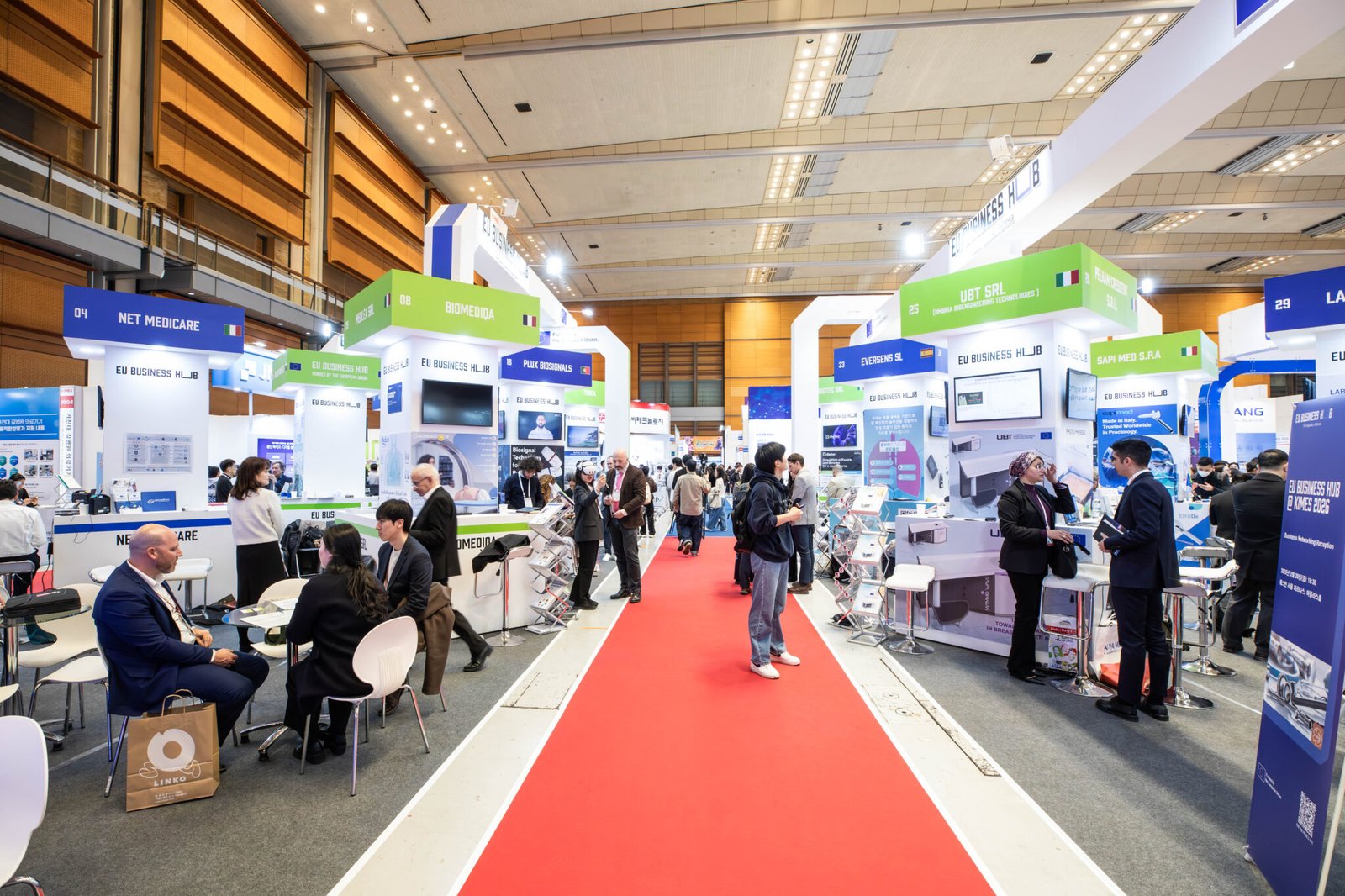
For European companies looking to explore these opportunities first-hand, the EU Business Hub – Japan and the Republic of Korea is currently recruiting up to 50 SMEs and startups for its EU Business Hub @ KIMES 2027 business mission to Seoul, taking place from 17 to 21 March 2027.
Selected companies will have the opportunity to showcase their solutions at KIMES 2027, meet potential Korean partners and customers, and receive tailored support to explore the market. Applications are open until 15 November 2026.
Here are five areas worth watching.
1. AI that solves real healthcare problems
The Republic of Korea’s strong digital infrastructure, advanced hospitals and expertise in artificial intelligence are creating opportunities for AI-enabled healthcare, from medical imaging and diagnostics to clinical decision support and workflow automation.
For European startups, however, simply adding AI to a product is unlikely to be enough. Hospitals need technologies that solve a specific clinical or operational problem and demonstrate measurable value.
Startup angle: Lead with the healthcare problem, not the algorithm. A clear explanation of how your technology improves outcomes, saves clinicians’ time or reduces costs is likely to be more compelling than an “AI-powered” label alone.
2. Remote care moves beyond the pandemic
The longer-term opportunity in telemedicine is the shift towards healthcare that can increasingly happen outside hospitals – particularly important for older people and patients living with chronic conditions.
This creates opportunities for remote patient monitoring, connected medical devices, digital therapeutics and platforms that help healthcare professionals follow patients between appointments. But the value proposition needs to go beyond collecting more data: it needs to help healthcare professionals make better decisions.
Startup angle: Show what happens after the measurement. Technologies that turn patient data into useful alerts, recommendations or clinical insights may have a stronger proposition than monitoring alone.
3. Healthy ageing becomes a technology market
As the population ages, demand is growing for technologies that help people remain healthier and independent for longer – from mobility and rehabilitation technologies to fall prevention, cognitive health, assistive technologies and digital tools for caregivers.
The strongest propositions may be those that address a very practical question: how can technology help an older person continue living safely and independently while reducing pressure on family members and care professionals?
Danish health-tech company Entertainment Robotics, which develops game-based technology for physical and cognitive training, joined EU Business Hub @ KIMES 2026 and connected with the Seoul Federation of the Korea Senior Citizens Association. The relationship developed into a strategic cooperation agreement aimed at expanding AI-enabled dementia prevention programmes across the country’s elderly welfare sector.
Startup angle: Think beyond the end user. In healthy ageing, the buyer may be a hospital, care provider, municipality, insurer or senior organisation rather than the older person themselves.
4. Smarter rehabilitation and assistive technologies
As populations age, healthcare systems need scalable ways to support recovery and maintain mobility. Advances in sensors, robotics, computer vision and AI are creating opportunities ranging from robotic and sensor-assisted rehabilitation to digital physiotherapy and movement analysis.
These solutions can augment the work of healthcare professionals, enable rehabilitation at home and provide clinicians with better information about patients’ progress. But clinical evidence and ease of integration remain critical.
Startup angle: Demonstrate how your solution fits into an existing care pathway. Saving clinicians’ time or enabling patients to continue treatment outside the clinic can be as important as the technology itself.
5. Connected healthcare needs better data
As healthcare becomes more digital, making different technologies and sources of health data work together is becoming increasingly important.
This creates opportunities for European startups working on healthcare interoperability, clinical data platforms, cybersecurity and tools that turn fragmented health data into actionable insights. Smaller companies do not need to replace an entire hospital IT infrastructure: solving one interoperability, security or workflow problem can provide a realistic entry point.
Startup angle: Integration can be a competitive advantage. If your solution can work with the systems hospitals already use rather than requiring them to rebuild their digital infrastructure, make that part of the pitch.
The opportunity is real – but market entry takes preparation
The Republic of Korea’s sophisticated healthcare market also sets a high bar for newcomers. European startups need to navigate regulatory requirements, clinical validation, reimbursement, data protection and localisation, while competing with established Korean and international players.
This makes the right local partner particularly important. A distributor, hospital or technology partner can provide access to customers as well as knowledge of regulation, procurement and purchasing decisions.
Neuroelectrics Barcelona joined two consecutive EU Business Hub healthcare missions to the Republic of Korea, establishing local distribution and reporting more than €50,000 in additional Korean revenue within a year of its first mission. According to the company, the programme shortened its market-access journey by more than a year.
From market opportunity to market entry
The upcoming EU Business Hub @ KIMES 2027 business mission will bring up to 50 European SMEs and startups to the Republic of Korea from 17 to 21 March 2027 to showcase their solutions at KIMES and explore opportunities across medical equipment, assistive technologies, digital health, remote monitoring, AI-enabled healthcare and regenerative medicine.
Selected companies will receive market intelligence and business coaching, tailored B2B matchmaking, interpretation support and financial support towards accommodation.
For founders considering the Republic of Korea, this provides an opportunity to move beyond desk research: to see how the market responds to their technology, understand what Korean healthcare organisations are looking for and start building the relationships that can make market entry possible.
Applications for EU Business Hub @ KIMES 2027 are open until 15 November 2026!