
The year ahead is likely to be a more affordable one for many homebuyers, even though home prices continue to climb for sellers.
The reason affordability improves is that we expect mortgage rates to be lower on average across 2026. In fact, monthly payments are projected to drop for the first time since 2020.
On top of that, incomes will grow, dropping the share of monthly payments—which buyers have to fork over to buy a typically priced home—below 30%. This builds on the modest improvement in affordability we saw in 2025 to bring the costs under this key benchmark for the first time since 2022.
Improving affordability will help bring more sellers back into the housing market, boosting inventory by roughly 9%. And buyers and sellers will more often meet in the middle, helping push transactions up a modest 1.7%.
For renters, I expect to see additional rent relief, though it’s worth noting that both the rental and for-sale real estate markets continue to vary locally, and you can explore the trends in your neighborhood in our Realtor.com® 2026 Housing Forecast.
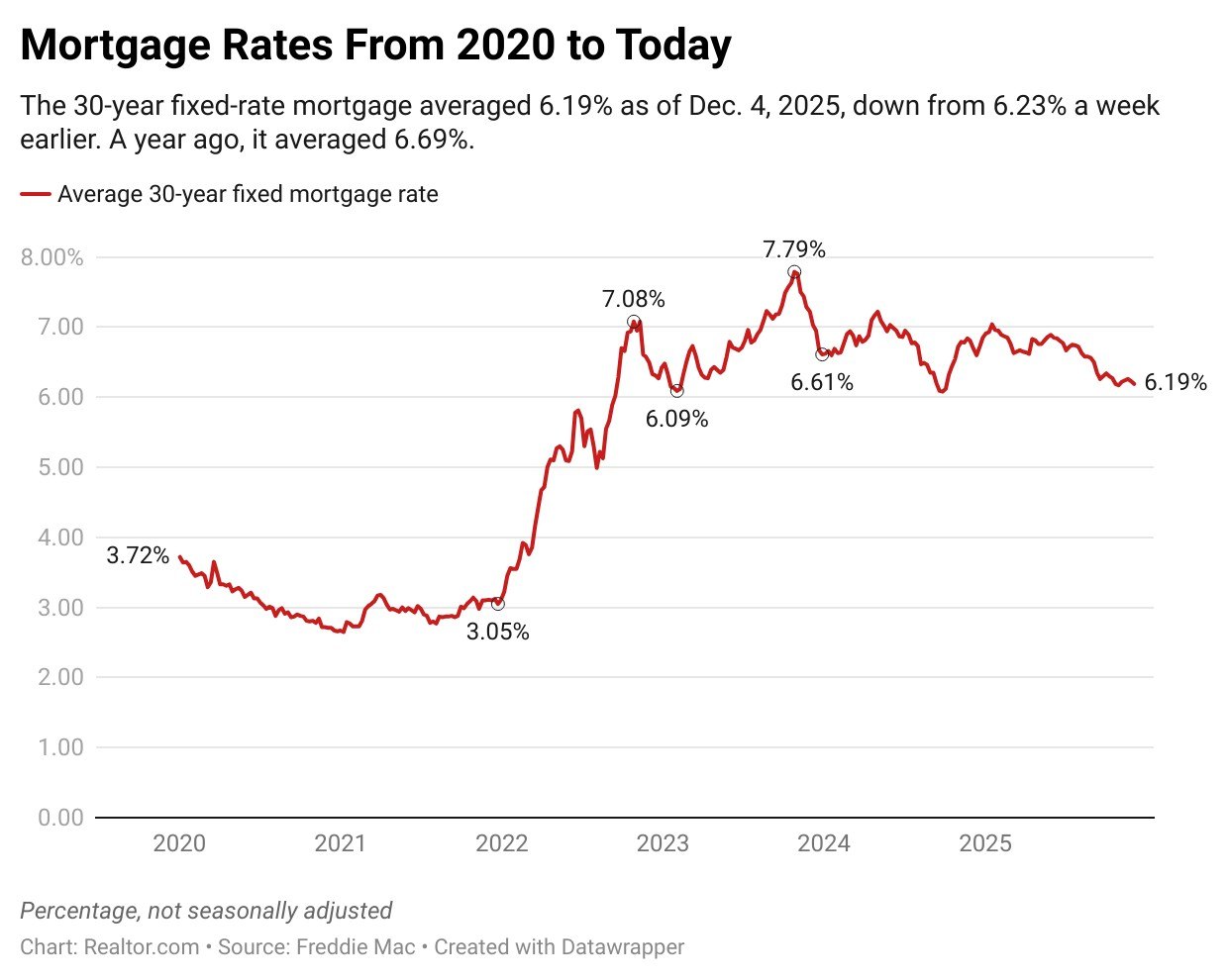
Consistent with our expectation that mortgage rates will remain low, mortgage rates dropped 4 basis points this week, moving toward the low end of the narrow range they’ve held since mid-September, which are some of the lowest rates since October 2024.
Mortgage rates for a 30-year fixed home loan decreased for a second week to 6.19% for the week ending Dec. 4, according to Freddie Mac. Rates averaged 6.69% during the same time a year ago.
In mid-November, rates edged higher as markets questioned the likelihood of a December Fed rate cut. As the meeting approaches, investors expect that the available data will be sufficient for a majority of the committee to support a rate cut, even as perspectives on the appropriate Fed policy rate continue to vary.
Put simply, even though the Fed is likely to cut rates at next week’s meeting, I don’t expect to see a big impact on mortgage rates. We could see more volatility as economic data, delayed by the government shutdown, continues to roll out. For now, mortgage rates are quite steady.
Weekly trends in housing data have also been relatively steady. Prices continue to hover close to flat—slipping slightly this week—as new listings ebbed and active listing growth slowed. Homes were on the market for two days longer than at this time last year, narrowing the gap with activity relative to earlier in the year.
Finally, let’s zoom in on the luxury trends in two pandemic-era hot spots: Nashville, TN, and Austin, TX. There are many commonalities between these two markets, but as the national luxury market has softened in recent months, Nashville’s high-end tier has remained steady. While both markets had similar luxury price points in 2018, Nashville’s high end is now more than a quarter of a million dollars more expensive.