
Here is the update for my Daedalus portfolio for February 2026. If work is not too busy, I will try to provide an update where possible.
I explained how I constructed this portfolio in Deconstructing Daedalus Income Portfolio and Why I Currently Invest in These Funds for Daedalus. You might not understand what I wrote below if you haven’t read this post.
All my personal planning notes such as income planning, insurance planning, investment & portfolio construction will be under my personal notes section of this blog.

You can also find the past updates similar to this in the personal planning notes section.
Portfolio Change Since Last Update
The portfolio was valued at $1.686 million at the end of January and is at $1.736 million at the end of February.
We reported a portfolio change of 2.9% or $50,000 for February 2026.
The portfolio is valued in SGD because that is the currency that I would most likely be spending on.
As of 5th March 2026, the portfolio is valued at $1.725 million.
Portfolio Attribution – Why did the portfolio do better/worse compare to last month [or a year ago if this is a December update]?
We all want to know what cause the portfolio to do better or worse. If you have just one fund that covers the MSCI World, or you have a bunch of funds, would you know if it did better or worse?
In this section, I try my best to explain the portfolio performance in my way.
Here are the primary security holding returns for the month-to-date and year-to-date for the funds that I own [the top fund table] and reference benchmark ETFs [the bottom Major Index ETF table]:

The table that shows the fund holdings denotes the month-to-date and year-to-date performance of the funds that I own, against Major Index ETFs. The Major Index ETFs is present to compare the performance. Just to be clear, I do not own the major index ETFs and you should see the top table (Fund) as what I own. The bottom table (Major Index ETFs) are benchmark ETFs to provide performance reflections.
The returns of all funds are in USD. This includes the performance of the Dimensional funds, which I use the returns of the USD share class so that the returns are comparable. I have also listed the major index ETF performance for comparison.
a. General Equity Performance
The MSCI World appreciated 0.76% for the month in USD terms and the emerging markets did better at 5.2%.
This will explain why the MSCI All Country World IMI and MSCI All Country World ETFs are doing better than the world because of their emerging market exposure.
If you see the S&P 500 doing -0.73%, it means international equity is doing better than the United States.
If you don’t understand that there is a difference between number performance and experience performance now you would know. If you were told that S&P 500 has better performance over many time frames (which is correct), you would have a WTF and “why is it like that?” feeling.
They are all natural. This is experience performance or performance experience. I cannot make up my mind.
b. Developed Equity Performance
There were a few multifactor funds targeting the developed equities region in Daedalus:
- JPGL
- GGRA
- AVGC
- IFSW
I hope you look at them as a diversified group of equities that gives exposure to developed large cap and mid cap global equities. They also systematically gives exposure to cheaper and more profitable companies with a little bit of short term momentum.
The overall valuation of this portfolio segment is lower than the market cap weighted index. The aggregate forward earnings growth of the portfolio should be reasonably high, despite the cheaper valuation.
The main comparison will be against the MSCI World.
JPGL is clearly the good performer. JPGL is like equal weighted or more neutral over the sectors so that means they have a higher energy and materials allocation and less information technology.
In some time periods, JPGL will look stupid but in a period where energy has done so well, you can see the impact.
IFSW did the worse and last year it was the best. I half suspect JPGL and IFSW will do this, which is why it feels stupid to reallocate away from JPGL, GGRA to put into IFSW and AVGC. The decisions that I make is not for today, tomorrow, a year later but for decade and in the middle, we won’t know how the market is but to have some trust in the factor methodology and see how it plays out.
One other thing: All of them including the Dimensional Global Core Equity did better than the MSCI World. They are all using different methodologies but in a way this is partially what the returns are showing us: There will be these ebbs and flows that in a broadening market, the biggest companies might not do well.
c. Developed + Emerging Markets Equity Performance
The Dimensional World Equity sits as part of my SRS account. It is a single fund that gives exposure to the developed and emerging markets large cap and mid cap stocks.
You should compare this against the MSCI All Country World.
World Equity continues to do well versus the index at 3.1% versus 1.3% or 1.5% whether you want to factor in IMI. I think you should which means that you should be comparing against the IMID.
d. Emerging Markets Equity Performance
AVEM and EMSD is my emerging market exposure. One is a large, mid and small cap fund that should tilt towards value and profitability. The other is a pure emerging market small cap with no factor tilts.
Both of them underperformance the benchmark index but their performance was not too shabby.
2 months into the year and AVEM is doing 13% and EMSD is doing 11%. AVEM is currently underperforming EIMI but slightly narrowing the gap. Emerging small caps is doing better than global small cap.
e. Small Cap Equity Performance.
About 32% of the portfolio or 36.5% of the equity allocation is invested in Global and US Small Cap Value or Value-weighted funds. You should look at Dimensional Global Targeted Value, AVGS and USSC.
- Russell 2000 did 1%.
- The more profitable S&P 600 did 2.7%.
- The midcap S&P 400 did 4.2%
We are starting to see the mid caps waking up!
More so in this broadening out, we see more participation from industrials which is a larger allocation to the more profitable small caps and mid caps.
The MSCI World Small Cap did 4.2%, indicating that international small caps is doing better and that less profitable small caps in the US is doing better.
- AVGS did 5.7%
- USSC did 3.3%
- Global Targeted Value did 3.7%
Shucks, I am not sure if I got the Global Targeted Value performance right but I cross checked against the UCITS ETF version (DDGT) and its showing 3.4% so I guess it is not too far off. Global Targeted Value is not doing as well AVGS, or the World Small Cap index and its hard to explain:
- If Global Targeted Value has a larger proportion of companies closer to mid cap, then it should do better.
- If they have not been doing as well because the securities selected is more deep value as opposed to more “flow” or profitability driven then I suppose at some point the deep value did well.
So this is a bit perplexing.
USSC is a little underwhelming but it is not doing anything out of the norms.
The methodology of Avantis would end up with a higher energy allocation than normal (but not super high its like 6-7%) and so since energy have done so well, AVGS benefited.
f. Global Aggregate Bond Performance
12.7% of the portfolio is in iShares Core Global Aggregate Bond UCITS ETF (AGGU).
The chart below is the US government yield curve at end Jan (Blue) and end Feb (Red):

The difference compare to last month’s update is that instead of a slight shift up, the curve shifted all the way down. When market interest falls, existing bond prices rise.
Thus AGGU did 1.2% in the month of February compare to just 0.17% in January.
g. Currency Effect
The USD weakened by 0.48% for the month against the SGD.
Since the portfolio is based in SGD, this currency weakness negatively affects the portfolio.
Role of Portfolio
The goal of the portfolio is to generate steady, inflation-adjusted income to cover my essential living expenses. It’s built using a conservative initial withdrawal rate of 2.0–2.5%, which is designed to hold up even under extremely tough market conditions — including scenarios like the Great Depression, prolonged periods of high inflation (averaging 5.5–6% over 30 years), or major global conflicts. In other words, it’s stress-tested to withstand some of the worst financial environments in history.
The income needs to last: from today (age 45) for the rest of your life — potentially forever.
I am currently not drawing down the portfolio.
For further reading on:
- My notes regarding my essential spending.
- My notes regarding my basic spending.
- My elaboration of the Safe Withdrawal Rate: Article | YouTube Video
Based on current portfolio value, the amount of monthly passive income that can be conservatively generated from the portfolio is

The lower the SWR, the more capital is needed, but the more resilient the income stream is.
Nature of the Income I Planned for
Generally, different income strategies produce different types of income streams. They can vary by:
- Consistency: Some provide steady income, others fluctuate over time
- Inflation Protection: Some adjust with inflation, others remain fixed
- Duration: Some last for a set number of years, others are designed to last indefinitely (perpetual)
An income stream based on the Safe Withdrawal Rate framework is consistent and inflation-adjusted, and if we use a low initial Safe Withdrawal Rate of 2.0-2.5%, the income stream leans towards a long duration to perpetual.
Here is a visual illustration of how the income stream will be based on the current portfolio value:

The income for the initial year is based on a 2% Safe Withdrawal Rate. The income for subsequent years is based on the inflation rate in the prior year (refer to the bottom pane of inflation in the previous year). If the inflation is high, the income scales up and if there is deflation, the income is reduced.
Amount of Cash Flow/Income Withdrawn/Extracted from Daedalus Income Portfolio
I wish to be fully transparent about the schedule of withdrawals from the portfolio because if the goal of the portfolio is eventually or currently provide income for spending, you would be interested to know how much is taken out from the portfolio.
There have not been any withdrawals or cash flow extraction for spending since the publication of the portfolio. I will update as and when it happens.
Investment Strategy & Philosophy
After trying my best to learn how to invest for a while, the portfolio expresses my thoughts about investing at this point.
The portfolio is run in a
- Strategic: allocation doesn’t change by short-term events.
- Systematic: rules/decision-tree-based implemented either myself or an external manager.
- Low-cost: investment implementation cost is kept reasonably low both on the fund level and also on the custodian level.
- Passive: I spend relatively little effort mentally considering investments and also action-wise.
You can read more in this note article: Deconstructing Daedalus My Passive Income Investment Portfolio for My Essential & Basic Spending.
Portfolio Change Since Last Update (Usually Last Month)
There are no changes to the portfolio in the last month.
Current Holdings – By Dollar Value and Percentages
The following table shows more details about the securities that I currently held.
The securities are grouped based on general strategy, whether they are:
- Fixed Income / Cash to reduce volatility.
- Systematic Passive, which tries to capture the market risk in a systematic manner.
- Systematic Active, which tries to capture various proven risk premiums such as value, momentum, quality, high profitability, and size in a systematic manner.
- Long-term sectorial positions.

Portfolio Grouped by Account Source Location
Generally, you won’t have just one view about the securities in your portfolio.
In the following sections, I show my portfolio when viewed from different angles.

The first is the portfolio based on location.
- Cash means held in accounts that we can make independent choices of which platform that we choose to invest in, when we decide to buy, when we decide to sell without any liquidity, tax, or locking considerations.
- SRS Account is a Singapore-related retirement account. There are tax advantages on your ordinary working income if a person contributes to it. You can defer the income tax until after your retirement, where only 50% of your withdrawal then will be tax, at the prevailing tax bracket then.
This view does nothing much but some might be curious whether it makes up my money in CPF, here or there and so basically these are basically my cash monies and SRS.
Portfolio Grouped by Geographical Region Exposure of Securities

The second view groups the securities based on its geographical exposure.
Returns comes potentially from taking systematic risks and risks comes partly from the macro, interest and inflation exposure in different geographical regions.
The general regions:
- Global Developed – Strategies that systematically considers the large-cap and mid-cap equities in developed countries. You can view the countries, and sector composition at this MSCI World Index page.
- Global Developed + Emerging IMI – Strategies that systematically considers the large-cap, mid-cap, small-cap equities in developed and emerging market countries. You can view the countries, and sector composition at this MSCI Emerging Markets IMI Index page.
- US – Strategies that mainly tap small-cap US equities.
Portfolio Grouped by Fund, Cash or Individual Security

The third view groups the securities based on whether they are fund, cash or individual securities.
Almost 100% of the portfolio is implemented with funds. Funds can be:
- Singapore Unit Trusts domiciled in Ireland.
- London Stock Exchange listed exchange traded funds (ETFs) domiciled in Ireland.
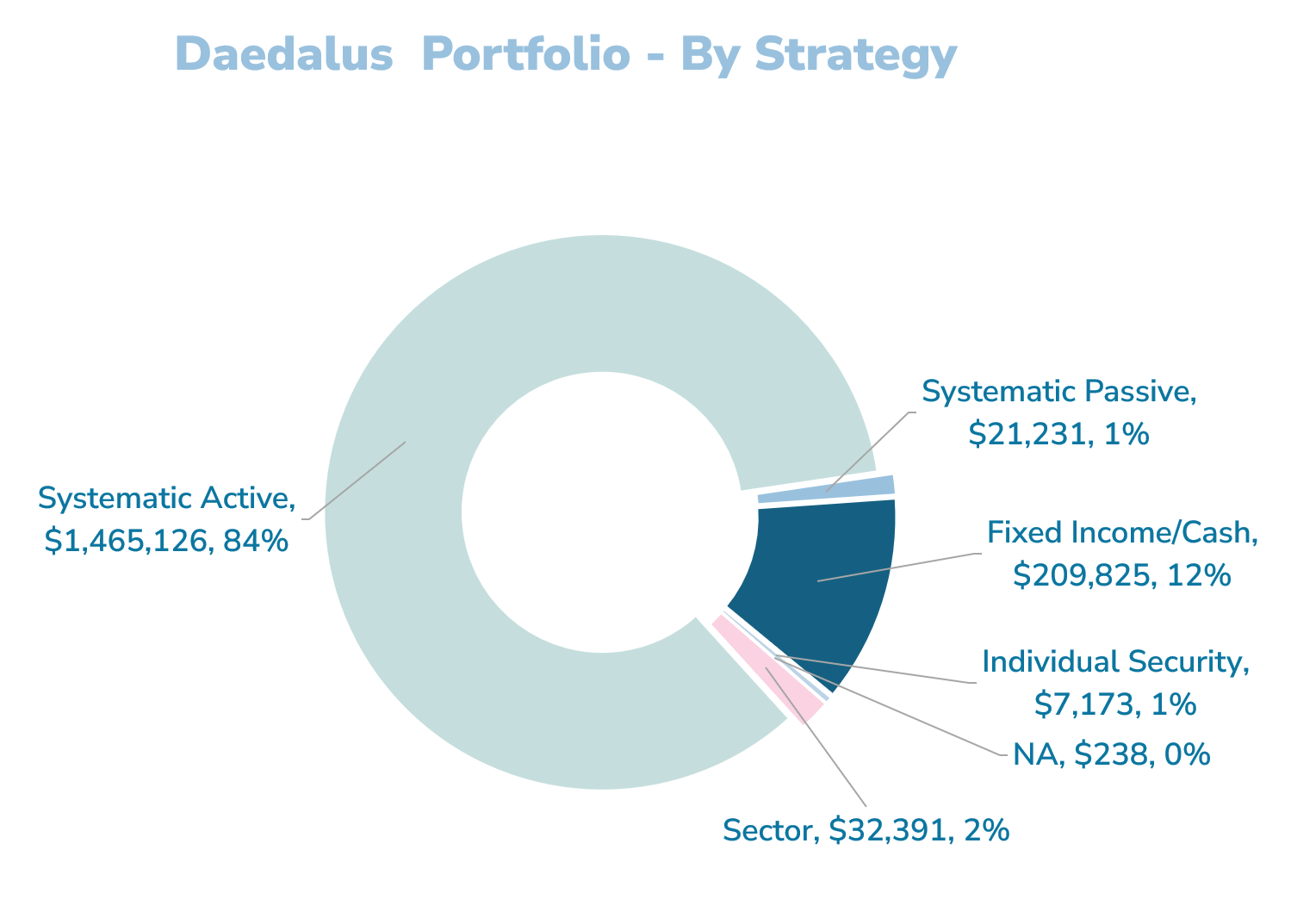
Portfolio Grouped by Strategy.

The last view groups the securities based on commonly known high level strategy names.
What Systematic Active Means: Funds that help me execute passively very specific, repeatable underlying securities selection on an ongoing basis. Here are some examples of the systematic active strategies in my portfolio:
- Global Multifactor: From a basket of 1,600 developed market large and mid-cap stocks, rank the stocks by their value, by their 12-month momentum, by their degree of ROE and debt to asset, and then own the top 300. Do this every half-yearly or quarterly. You end up with a strategy that consistently owns 300 companies that are cheaper, quality and have greater momentum relative to a market cap weighted index.
- Small Cap Value: From a basket of 3,000 developed market small cap stocks, rank the stocks based on price-to-book value (include intangibles in the book value). Also rank the stocks by operating earnings minus interest divide by book value. Eliminate the companies with low profitability. What we end up is two group of small cap stocks: The more profitable small caps but not too expensive, and the small caps stocks that are at least profitable but are very cheap. Own the top 30-35% of this cohort consistently. Have a manager that consistently helps me execute this.
In contrast, Systematic Passive are funds that help me track certain benchmark indexes. These indexes can be market-cap weighted, or equal-weighted, and reconstituted periodically so that they mirror the performance of benchmark indexes.
Sector are the funds that provide exposure to risks of certain sector such as semi-conductor or energy as an example.
Fixed Income/Cash main helps damp the volatility of the portfolio. They are maintain based on the historical research that it is better to be less than 100% in equities if your portfolio is meant for income.
The fixed income/cash should not be viewed as a war chest to rebalanced to equity or take profit from equity. This is a strategic long term allocation whose main purpose is to optimized negative sequence of return risks.
The Main Custodians for the Securities in this Portfolio
The current custodians are:
- Cash: Interactive Brokers LLC (not SG)
- SRS: Philips FAME

Do Like Me on Facebook. I share some tidbits that are not on the blog post there often. You can also choose to subscribe to my content via the email below.
I break down my resources according to these topics:
- All my personal notes about how my philosophy behind my own money and how I manage it.
- Building Your Wealth Foundation – If you know and apply these simple financial concepts, your long term wealth should be pretty well managed. Find out what they are
- Active Investing – For active stock investors. My deeper thoughts from my stock investing experience
- Learning about REITs – My Free “Course” on REIT Investing for Beginners and Seasoned Investors
- Dividend Stock Tracker – Track all the common 4-10% yielding dividend stocks in SG
- Free Stock Portfolio Tracking Google Sheets that many love
- Retirement Planning, Financial Independence and Spending down money – My deep dive into how much you need to achieve these, and the different ways you can be financially free
- Providend – Where I used to work doing research. Fee-Only Advisory. No Commissions. Financial Independence Advisers and Retirement Specialists. No charge for the first meeting to understand how it works
- Havend – Where I currently work. We wish to deliver commission-based insurance advice in a better way.

Kyith is the Owner and Sole Writer behind Investment Moats. Readers tune in to Investment Moats to learn and build stronger, firmer wealth foundations, how to have a Passive investment strategy, know more about investing in REITs and the nuts and bolts of Active Investing.
Readers also follow Kyith to learn how to plan well for Financial Security and Financial Independence.
Kyith worked as an IT operations engineer from 2004 to 2019. Currently, he works as a Senior Solutions Specialist in Fee-only Wealth Advisory Firm Providend. All opinions on Investment Moats are his own and does not represent the views of Providend.
You can view Kyith’s current portfolio here, which uses his Free Google Stock Portfolio Tracker.
His investment broker of choice is Interactive Brokers, which allows him to invest in securities from different exchanges all over the world, at very low commission rates, without custodian fees, near spot currency rates.
You can read more about Kyith here.