

Rick Mills, Editor/ Publisher, Ahead of the Herd:
Louis, you’ve been in the exploration development business for
many years. Could you please tell us where your knowledge base lies
and a little bit about yourself.
Louis Martin, Harvest Gold Senior Technical Advisor:
Sure. I guess we can move quite a ways back. I was born in a mining
town up in northern Quebec, my parents worked there so I was
actually born into the industry.
I did my university degree in Montreal, and right after graduating,
that same week, I went up to the Val d’Or area in the Abitibi
and started working. It was supposed to be a one-month contract, but
I’ve been in the Abitibi now for over 40 years, so I know the
area quite well.
I’ve moved all over in the Abitibi. I’ve done the Val
d’Or camp. I’ve done the Noranda camp. I’ve been
in the Timmins camp. I’ve always liked the Abitibi.
RM: You were part of the exploration teams
that were awarded the Discovery of the Year by the AEMQ for the West
Ansil Deposit and the Louvicourt Deposit. You’ve also worked
on several advanced exploration projects including bringing four of
these projects into production. You were also Vice President of
Exploration with Clifton Star Resources, that team completed a
Pre-Feasibility study defining the 4.5 million-ounce Duparquet Gold
Project.
Now, after 4 decades plus you’ve landed here.
LM: Rick Mark (Harvest Gold’s CEO) asked
me to take a look at the Mosseau project, it was in my backyard.
I’ve driven past it, I knew the area and I liked it.
You’re looking at a style of mineralization that I really
liked, and it’s a good-sized property, about 18, 20 kilometers
along the strike, so yeah.
The northern part had a lot of previous work, with 16 known gold
showings. From a geology point of view, that means there’s a
lot of smoke in the area.
So, that attracted us to the property, but as you work your way
down, the central portion, the southern portion, the amount of work
decreases as you go southwards.
We all thought that’d be a great property to acquire and do
exploration work on.
RM: You look at a map on the corporate
presentation, and the Abitibi is huge, but why is the Abitibi so
richly endowed? There’s just mine after mine, and
they’re very high-quality mines. What is it about the Abitibi?
And in particular, what about the Urban Barry part of it stands
out?
LM: I’ll try not to go too technical
into it, but it’s the rock types.
We have Archean greenstone belts. These are some of the oldest and
most favourable rocks in the province and even in the world.
They’ve gone through a lot of deformation, where the rocks get
moved, compressed, pulled apart. When you have that kind of
structure going on, you have the fluids from deeper down that
contain the gold which comes up along the regional deformation zones
and develops into gold deposits.
On a regional scale these structure are very linear. A lot of
these structures, you’ll hear people talk about the
Cadillac-Larder Break, the Destor-Porcupine Break. And in our case
here, we’re up in the Urban Barry belt and its associated
deformation zone.
It’s just a question of good rocks, good structures, good
mineralization underlying, and it makes nice gold deposits.
RM: When you’re planning the
exploration, what techniques would you use to find potentially the
right rocks for a deposit?
LM: For a geologist it’s fairly straight
forward, you always do a big compilation of all the available data
first. We started by reviewing all the historical maps available.
The Quebec government has an excellent database, so you can do
queries including, “Showing all the gold deposits out
there.” You can see these clusters developing. Then you throw
in other queries. “Show me the ones that have volcanics or
sedimentary rocks associated with it.” That’s where we
start seeing the Urban Barry belt. Then you add another query.
“Show me where there’s fault structures that could be of
interest.”
RM: Now, what about the north part of the
Mosseau? What attracted you about that? What about that area
coincides with what we’ve talked about already?
LM: I think the biggest focus was the number
of showings. To me, when you get that many showings, you know
there’s a lot of smoke in the area. That’s what focused
us into that part.
RM: Can you explain to us about the dilation
zones and vector halos, basically what did we find there and why
we’re excited about it?
LM: I’ll start out with the dilation
zone. Essentially all of the province of Quebec has been flown,
covered, with airborne magnetics by the government. They were flown
at a very large-scale, with the lines were quite far apart. It
wasn’t very detailed, but at least the data tells you
you’re in the right rock types.
So, we went in to the area and flew a very high-resolution mag
survey. So rather than having flight lines like at 250, 300 meters
apart like the government, our flight lines were at 50 meters
spacing and a much lower elevation.
What that means is you can start seeing geological structures
developing a lot better. Dilation zones are created by having rocks
moving side by side, opening up, creating a zone of low pressure.
When you have that low pressure zone, the gold bearing fluids are
able to move up along the rocks and structures a lot easier.
Doing the high-resolution magnetic survey, we were able to suddenly
realize, “Oh, there’s a dilation zone, low pressure, a
lot more fluids.” You can make similar analogies with other
deposits throughout the Abitibi.
We said “Okay, let’s focus on that structural
zone.” We overlaid all the historical gold showings. We then
noticed that the majority of those gold showings are directly
related to this dilation zone, that zone of low pressure.
So that’s what focused us in on the northern portion of the
property. We know there’s gold mineralization. We want to
examine that area in detail and get more information on the style of
mineralization. It’s not just a question of reviewing a
historical 1950 or 1980 geological report, but you want to drill and
collect good samples of the mineralization. So, we drilled a couple
of holes into that dilation zone near some old showings.
And, again, we wanted to see maybe if those old gold showings have
roots or deeper sources. So, we drilled a couple of holes below the
showings. And that’s where we started seeing what was hidden
in the ground. We’re seeing gold mineralization, yes, but
we’re also seeing gold associated with some silver and copper
mineralization.
We’re seeing a very nice mineralogical association with the
gold-silver and copper occurring together. Historically, the
previous explorers were focused on high-grade gold mineralization.
Well, we turned that around and said, “What if we applied a
lower grade gold threshold or cutoff?” The price of gold has
skyrocketed, so the cutoff rate should be a lower, too.
Applying these lower cutoff grades, we’re suddenly seeing that
we’ve got broad zones with identifiable gold and or copper
halos. These broad halos are connecting up and highlighting the
better zones.
That’s what we are focusing on at this point in time,
it’s not just small high-grade intersections, but broad zones,
and these broad zones should be leading us towards the larger richer
areas of mineralization.
We’re also looking for important geological structures. We
want to be in a mineralized shear zone, and again, not just a narrow
six-inch shear zone, but as we are seeing in our drill hole results,
multi-meter, 10, 20, 30-meter wide shear zones, that’s a good
size zone to be in.
The nice thing about those kinds of things, halos and shear zones,
is they usually have good continuity, both along strike and at
depth. So, if you’re hunting for elephants, you want to have
those large, mineralized halos, important structures and shear
zones, all things that indicate good continuity.
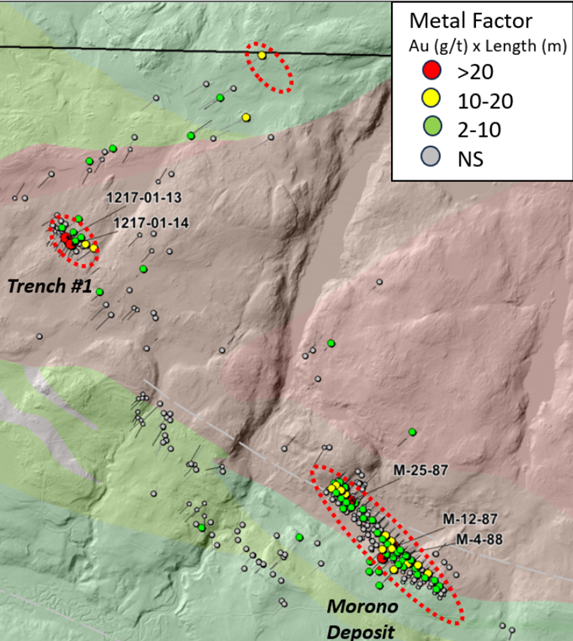
RM: What did we discover?
LM: Well, the first hole was one of the more
interesting mineralogical and high-grade holes, where we got some
very nice mineralization, including silver and copper. We’re
talking 8.7 grams per tonne gold, 203 grams of silver, 2.26% copper.
That sort of woke us up and said, “Whoa, it’s not just a
gold showing out here, but it’s a multi-element showing.
It’s got both precious and base metal mineralization; we
really liked that part.”
But it was the next couple of holes where we started seeing that
it’s not just narrow high-grade mineralization, there are
broad mineralized zones out there. From that we started fine-tuning
our geological story on the northern part of the property.
We were able to relook at the 16 known gold showings and multitude
of gold intersections and review it with our new ideas that included
multi-element mineralization and wider halo zones. This compilation
allowed us to narrow our focus on three particular areas in the
northern part of the property. “Now we’ve got three
target areas we want to follow up with diamond drilling next
year.”
RM: Let’s move down to the central part
of Mosseau and take a look at the recently released assays. You
worked up a number of drill targets, we drilled, and we’ve now
got five holes back, with more coming. What was the impetus for
going into that particular area?
LM: We started our exploration program in the
north part of the property, it was a good area to learn and apply
our theories, because of the amount of known mineralization in the
area.
What we learned from the northern part, we were able to apply to the
central portion of the property. The central portion had a lot less
previous work and exploration. One of the reasons is the northern
part was developed earlier and had more forestry access roads, so
more prospectors, and more exploration companies can get in there
and do work.
With the high-resolution mag we had flown in the north, we were able
to use those same criteria when looking at the central part and say,
“Hey, we’ve got a similar, yet large dilation zone out
here too.” We’ve got the shear zones that we’re
seeing in the north continuing across. We did a soil geochemistry
survey last fall, something that had never been done on the
property.
Then we started seeing these gold dispersion trains being identified
in the central part of the property. So, we said, “Let’s
overlay the mag, the structural zones, the favourable geology, the
soil sampling results, and with this we began the targeting
process.”
We defined 10 targets in the central part. At this point in time,
we’ve released the assay results of the first five holes in
the central part of the property.
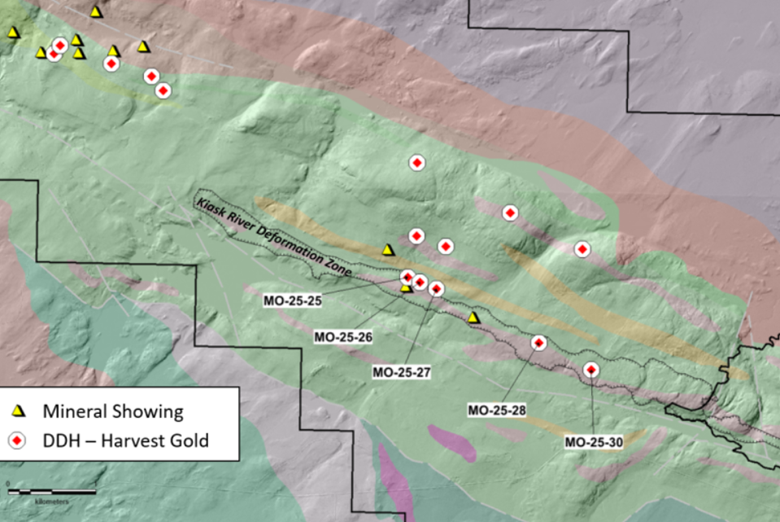
RM: The Kiask River Deformation Zone, does
that have the same kind of rocks as what we’re looking for, a
comparable to Windfall?
LM: Yes, we’re still in the same type of
favourable greenstone rocks. Again, we’re in the Abitibi,
we’re in the volcanic sequence. Windfall represents a
structural splay off the Urban Barry Deformation Zone, and
we’re drilling on a similar structure. Almost like a mirror
image of it, except with a northwest-southeast direction.
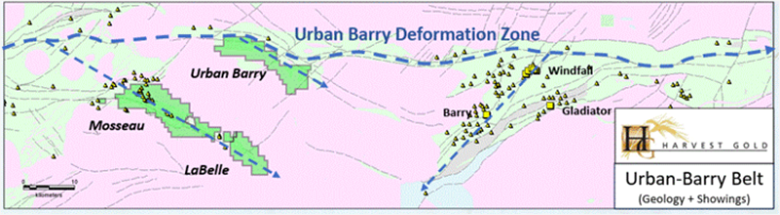
RM: What do you think was the most important
hole and why? What do we see from the results?
LM: I’m more excited about the central
holes than I am about the northern ones. The northern ones were good
learning holes allowing us to develop our theories. I think there
are still excellent targets to go after in the northern part, but
the central holes, that is where the excitement is, those five
holes, all hit broad mineralized halos. Some of those intersections
measure from 7 meters up to 21 meters in width.
All five of them line up in a row and intersected the targeted shear
zone.
There’s a broad halo with gold mineralization, and there is
some copper and silver in there also. So, I think it proves up our
concept that this is an excellent mineralized structure to explore
along. And, again, focus on its extensive strike length.
We did only five holes on this structure, but from prospecting and
other work, we know it extends at least 3 kilometers along strike.
Looking at the mag data, we can easily triple that strike length
opening up new exploration targets.
RM: How important was it to have that visible
gold, the VG?
LM: I think the visible gold is important. It
proves up our concept that high-grade mineralization does exist. The
visible gold, with 105 grams is one sample, with the grade averaged
out over the entire length of that sample.
There are multiple specks of visible gold in that sample. But more
importantly, it was in the right rock type and shear zone that we
were targeting.
Our exploration focus will continue testing those wide shear zones
as defined by the gold and or silver and copper halos.
The follow-up work will consist of following those halos and finding
out where they’re going to concentrate the gold.
Our very first hole, hole SW-25-25, did get that right. It
intersected a 7-meter wide shear zone or halo with mineralization.
And right next to it, there was the 105-gram material. So, it does
prove the concept of the best place to be is along that wide shear
zone.
And, again, those multiple widths, that long strike length says
it’s going to be a big system.
RM: And potentially a rich one.
LM: That’s the whole goal; we want to
find where we get a combination of nice shear zone widths and
high-grade gold material.
RM: Well, I’m happy that there’s
high grade gold in the Kiask River Deformation Zone.
LM: The first holes we did were on a short
section of the Kiask River Deformation Zone. There was one small
part that had some previous mechanical overburden stripping. You see
these nice, wide shear zones, with good strong carbonate alteration.
Even a non-geological person could see this outcrop and comment,
“Wow, that looks like really interesting rock.”
It’s very different from the rocks on either side. Vior, had
explored in the area in 2017, one of their drilled intersected
anomalous gold, including 2.93 grams over 5 meters, and wider halo
material also.
Harvest went in this area and said, “Okay, let’s drill
along strike to test the continuity,” and we got even better
numbers. But the thing is, we still have a lot of strike to cover
for that whole mineralized horizon, the Kiask River Deformation
Zone. For future exploration drilling, we can go in there and start
drilling, below that 105-gram intersection at depth, plus we can
drill along strike from it.
Elsewhere in the central part of the property, we’re targeting
similar, parallel magnetic features, alongside the gold dispersion
trains from the soil sampling. Much of the central part of the
property still has lots of grassroot targets that are underexplored.
And if it’s anything like the northern part, we can expect
multiple stacked shear zones.
RM: How about a wrap-up.
LM: I think the exploration project went very
nicely. We drilled the northern part of the property in areas where
there were known gold mineralization. We learned a lot from that
work and developed new theories for locating the gold. So,
we’ve come out with this multi-element story that not only
includes gold but its association with silver and copper.
We’re fine-tuning our targeting approach with the broader halo
story.
We have now applied that knowledge to the less explored central part
of the property. And, again, it’s confirming what we have
learned to the north, but now we have a much bigger target area to
explore.
And that’s what we’re going to be doing in the next
exploration program. It’s continuing to follow-up on those
northern targets, but at the same time returning to the central area
where we have a bigger and less explored exploration area.
On top of that, we have the southern part of the property that
hasn’t even really been explored. We did a little bit of soil
geochemistry last fall. We’re still waiting for results. And,
again, we plan on developing more targets down there, similar to
what we did in the central part.
RM: We’ve explored a very small part of
the overall property package.
What we’ve done already, we’ve talked about, but
let’s look at what’s left of the three properties and
structure that we have to look at.
LM: As far as exploration, our model is very
simple, we believe there are multiple mineralized shear zones on the
property, many that have never been tested. So, when I talked about
3 kilometers or 10 kilometers of strike, remember that’s one
horizon, but just imagine several mineralized shear zones stacked
one on top of the other. The Mosseau property has also been expanded
down towards the southeast by some new staking.
And then we have the LaBelle property that we staked, which is
entirety 100% owned by Harvest Gold. So again, this gives us several
more kilometers of strike length to explore.
Apart from this we also have the under explored Urban Barry property
to the north. The property has a little bit more overburden
coverage, but we just finished off a till survey late last fall and
we’re waiting for the results. This property still remains a
grassroots exploration play but in highly favourable geology.
We are advancing all our projects with known or acquired data, to
testing geological models, to developing targets for future
exploration.
RM: Rick, thank you for your patience, what
would you like to say?
Rick Mark, CEO, Harvest Gold:
What I’ve been trying to do, Rick, and I think you understand
this, over the last five weeks or so as we are learning more, my
role is to try to translate this story and take, if you like, the
half an hour you spent with Louis and turn it into three or four
minutes of really an opportunity story, a value proposition story.
And I think without question, the 105 grams per tonne gold story
headline yesterday clearly drove the market. We traded over 4
million shares, touched 10 cents again. So, we’re in the right
place.
What we’ve done is taken our 20-kilometer long Mosseau
property, one of our three properties that totals 50 kilometers.
We’ve taken a large, long property and put 20 holes in
it, Rick. That’s all we’ve drilled, just 20 holes.
Think about that. It’s a good perspective for investors and
shareholders to understand.
We put together a pretty nice, smaller, extremely high-grade hit.
That tells the audience that there’s high-grade gold in this
system. Remember, 20 holes over 20 kilometers.
So, what have we accomplished? Well, we had a small defined zone to
the very north that we really considered a secondary target. But by
using our copper, silver, gold halo set of glasses, Louis has now,
at this point, defined targets there. We look at Trench 2, where we
talked about high gold grades, we went back with our new set of
glasses. We’ve got six to eight targets there.
And we are going back to the more explored Morono area, which
everyone has known about in this community for 45 years. Morono was
what was known about Mosseau and blown off to a certain extent even
by us, Rick, as not enough ounces, albeit near surface, within the
first couple of hundred meters, but not enough ounces to build a
company around. Now we’ve finally drilled under Mosseau, and
we’ve got 10 meters and 19 meters of evidence that we’ve
got a different kind of mineralization.
We also went 300 meters along strike to the southeast, where we
noticed this copper result in surface grab samples. One of our guys,
Warren Bates, was really enthused about that.
So, Louis took that and developed some targets and what have we now?
With the new set of glasses, we’ve got multiple targets at
Morono.
You, I, and most people thought the north didn’t have much
going for it. Now we know that it’s got a great deal going for
it. That’s tremendous.
That’s a tremendous discovery by Harvest Gold. And now in the
Kiask River Deformation Zone, another discrete area, albeit still
limited testing over 3 kilometers of strike length, we’ve
added five more holes to make nine holes, Vior did four in 2017.
Nobody’s really been here. And so, we’ve got another
discrete zone highlighted by this incredible look at 105 grams of
gold over about 4 feet, bringing the market’s attention to the
company. Fantastic.
But as Louis says, it reinforces our hypothesis that this has much
more to go. So, at this point, we’ve reduced 20 kilometers
with 20 holes to four discrete areas, albeit one of them still quite
large. And now drilling is more targeted with a better set of
glasses to help us understand and track through this gold, silver,
copper halo, how to track the evidence of the mineralization.
RM: People are paying attention to what
Harvest is doing, and your results.
RMark: The neighborhood is getting busy. While
we were working over the last year, Vior led the way, and anything
that came available to the north of Mosseau, to the south of
Mosseau, and to the north of LaBelle, they were staking up and
putting inside our agreement, which we were very pleased about. We
did some staking as well, but it was interesting in December, our
land management woman said to us, “There’s some claims
coming up to the north of Mosseau, and there’s a bit of a
lineup.”
I thought there were six people in line, Rick, and there were 42
people in line for six claims. So, this neighborhood, albeit
assisted by Goldfield’s $4 billion purchase of Windfall, but
without question assisted by Harvest Gold’s taking on 50
kilometers of strike length in this belt and in this splay, has made
this neighborhood more important.
When 42 people are lined up to get six claims, I think we can say to
the market we are in a neighborhood that has perceived value, and
that’s one of the ways in this very difficult time and stage
of an early exploration company to tell the market this real estate
has value.
RM: What do you want to accomplish this year?
RMark: The last thing I’ll say, and this
is very important to our shareholders, we want to own 100% of
Mosseau. That is our goal in 2026, and as early in 2026 as we can.
Someone asked me, and I was pleased to be able to say it for the
first time, “What do we look like a year from now?” And
I’d say with some confidence, what we look like a year from
now is a company that has now got more focused drilling through the
discrete areas that Louis and I have mentioned, that we’ve
described in our press releases. And we put enough holes in that to
establish ourselves as on track to find deposits.
We’ll have a stock price that’s much higher. We’ll
own 100% of Mosseau, and we’ll own 100% of Urban Barry and
LaBelle, having 50 kilometers of strength length in the Urban Barry
Belt. We’ll raise 10 to 20 million dollars at a much higher
price, or we’ll take this 100% of Mosseau, and we’ll
start talking to others who might want to stop our dilution and
allow us to dilute the property, which if done properly, would be
very advantageous to our shareholders.
So, what have we accomplished in ‘25? I think we’ve
accomplished a great deal. And we are going to accomplish a lot more
in 2026.
I’m very proud of the team, and Louis has done a fabulous job.
What are we going to accomplish in 26? Well, I think this next step
will be that leap step. I believe we’ve taken a big leap in
‘25. The market just doesn’t show it yet. We’re
still sitting an $8 million valuation. Forty-two people want six
claims anywhere near us, and we’re only at an $8 million
valuation.
We’ve got more work to do, but now the work is extremely
focused. We no longer are poking 20 holes in 20 kilometers,
we’re totally dialed in and I think that’s a compliment
to the whole team, and particularly Louis and the geo team.
RM: Harvest Gold has 50 kilometers of strike
length in the Abitibi. We’ve got confirmed mineralization,
polymetallic. We’ve got vectors. We’ve got halos.
We’ve got dilation zones. We have deformation zones. We have
multiple stacked and wide shear zones.
You’ve confirmed where there is a lot of smoke, you have fire
present, there’s mineralization. The drill results confirm
what we thought, you have confirmed the exploration potential of
that 50 kilometers of strike length.
Is there anything you wanted to say and wrap up, Louis?
LM: I think we covered most of it right there,
and the biggest thing, it’s an underexplored greenstone belt.
We’re using modern exploration techniques, whether it’s
high-resolution mags, soil geochemistry, it’s pointing us to
the targets. So far, the success rate is good, so I’m quite
happy with our work. We still have a lot of property to explore
along the strike and the other properties.
RM: Thank you, Louis, pleasure meeting
you.
Rick, would you like to wrap up?
RMark: I think, as I described it, it’s
a difficult pathway for early-stage companies. We made the decision
against some people’s advice to take on the size of properties
that we have, and I wanted to be sure that we had enough weight to
build the company around, enough substance, and I think we are in
the process of, as the market around us begins to value this area
more, as evidenced by, obviously, the $4 billion Gold Fields Osisko
buy and the kind of activity we’re seeing in claim staking,
but also the work that we have done now.
Going back and looking at what people have looked at for 45 years, I
love the story, Rick, of looking through a different set of glasses.
It’s quite remarkable what it’s done for our ability to
better understand what we have, and most importantly, and this is
why I’m so confident about this next drill program, our
targeting ability has been enhanced.
We have a sharper focus. We have new pathfinders, and that’s
the kind of thing that will give me confidence to say, as I said,
this next drill program, we will expect results that will then
impact the market.
The longer-term players looking at what we have today at an $8
million market cap, you’ve got to own this stock and trust us
that we’re going to spend that money wisely.
I think the people that know us well know that we do that, and that
when we get to drilling, when we get to using the money for
exploration, that this team knows what they’re doing, but
there’s so much more to go, and I think who we are today after
a year of this work on Mosseau we are a much smarter, better, and
bigger company, and yet our market cap has hardly changed, and I say
to investors that’s an opportunity.
RM: Thank you, Rick.
RMark: Thank you Rick, I really appreciate
it.
Investorideas.com
is the go-to platform for big investing ideas. From breaking stock
news to top-rated investing podcasts, we cover it all.
Mining stocks -Learn more about our news, PR and social media,
podcast and content services at Investorideas.com