
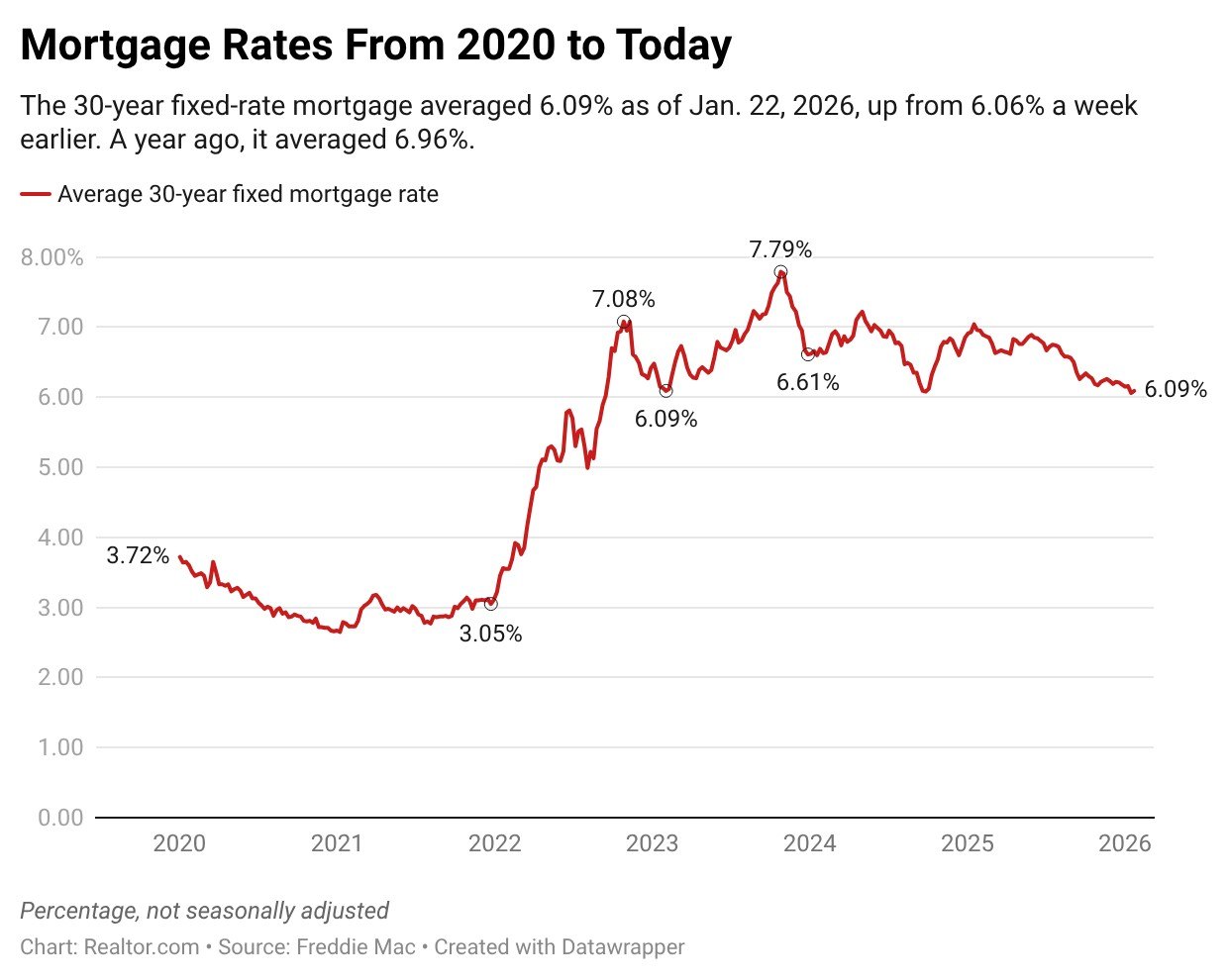
Mortgage rates ticked up on Thursday, a week after dropping to their lowest level in more than three years, amid volatility in the bond market stirred up in part by ongoing tensions between the U.S. and the European Union over Greenland.
The average rate on 30-year fixed home loans increased to 6.09% for the week ending Jan. 22, up from 6.06% the week before, according to Freddie Mac. For perspective, rates averaged 6.96% during the same period in 2024.
“With the economy improving and the average 30-year fixed-rate mortgage nearly a percentage point lower than last year, more homebuyers are entering the market,” said Sam Khater, Freddie Mac’s chief economist. “Buyers always should shop around for the best rate, as multiple quotes can potentially save them thousands.”
The 10-year Treasury yield, which rates track closely, climbed earlier this week to a 4.25%-4.3% range, the highest since last August, driven upward by a bond sell-off fueled by rising international trade tensions.
Realtor.com® senior economist Anthony Smith points out that last week’s downward movement followed President Donald Trump’s announcement of a $200 billion mortgage-back securities (MBS) buyback plan, but its impact on borrowing costs proved short-lived.
With December’s jobs report showing slower hiring yet a lower unemployment rate and firmer wage gains, Smith says there is now less urgency for the Federal Reserve to cut interest rates in the near future.
With the next Federal Open Market Committee Meeting (FOMC) less than a week away, financial markets now put the probability of the Fed holding interest rates steady at their current 3.5%-3.75% range at 95%, according to CME FedWatch.
Pending home sales fell 9.3% month over month in December as limited new listings and still-high prices sidelined buyers.
“While mortgage rates reached their lowest level of the year in December, affordability remained strained,” says Smith. “Inventory recovery continues to diverge by region, with the South and West seeing the most improvement.”
Recent policy actions added to volatility, with the Trump Administration offering no details on the implementation of the proposed $200 billion MBS buying spree.
A separate executive order outlined a framework to restrict institutional investor participation in housing markets, but Smith says with key enforcement details still undefined, any near-term effects are likely to be limited and concentrated in select metros.
“Looking ahead, affordability remains the central issue,” notes the economist. “Labor market stability and real wage gains will be needed to support housing demand, but a gradual and uneven recovery remains the likely path forward.”
How mortgage rates are calculated
Mortgage rates are determined by a delicate calculus that factors in the state of the economy and an individual’s financial health. They are most closely linked to the 10-year Treasury bond yield, which reflects broader market trends, like economic growth and inflation expectations. Lenders reference this benchmark before adding their own margin to cover operational costs, risks, and profit.
When the economy flashes warning signs of rising inflation, Treasury yields typically increase, prompting mortgage rates to go up. Conversely, signs of falling inflation or weakness in the labor market usually send Treasury yields lower, causing mortgage rates to fall.
The mortgage rates you’re offered by a lender, however, go beyond these benchmarks and take some of your personal factors into account.
Your lender will closely scrutinize your financial health—including your credit score, loan amount, property type, size of down payment, and loan term—to determine your risk. Those with stronger financial profiles are deemed as lower risk and typically receive lower rates, while borrowers perceived as higher risk get higher rates.
How your credit score affects your mortgage
Your credit score plays a role when you apply for a mortgage. A credit score will determine whether you qualify for a mortgage and the interest rate you’ll receive. The higher the credit score, the lower the interest rate you’ll qualify for.
The credit score you need will vary depending on the type of loan. A score of 620 is a “fair” rating. However, people applying for a Federal Housing Administration loan might be able to get approved with a credit score of 500, which is considered a low score.
Homebuyers with credit scores of 740 or higher are typically considered to be in very good standing and can usually qualify for better rates.
Different types of mortgage loan programs have their own minimum credit score requirements. Some lenders have stricter criteria when evaluating whether to approve a loan. They want to make sure you’re able to pay back the loan.