
On February 27, an Australian federal court handed down the largest
native title compensation award in the country’s history.
The mine at the centre of the case produces silver. The precedent it
sets affects every future mining expansion on the continent, and
beyond.
The silver supply story is usually told in terms of geology, grades,
and mine development timelines. It is less often told in terms of
courtrooms. That is beginning to change.
On February 27, 2026, Australia’s Federal Court handed down a ruling
in the case of Davey v Northern Territory that Norton Rose Fulbright’s legal analysis immediately identified as a landmark: AU$54.7 million in compensation awarded to Traditional Owners of lands encompassing the
McArthur River Mine in the Northern Territory. It is the largest
native title compensation award in Australian history, and only the
second time a superior court in Australia has actually quantified
such a claim.
The McArthur River Mine is not a peripheral silver operation. It is
a major zinc, lead, and silver producer operated by Glencore (one of
the world’s largest commodity companies). Australia, as a whole,
produced 38.8 Moz of silver in 2024 per
the World Silver Survey 2025, a 19% year-over-year increase. That supply is now operating under
a fundamentally altered legal environment.
There are six Deep Dives that I’m discussing in this week’s
premium Silver Catalyst issue, and in this article, I’ll focus on one of them.
What the Davey Decision Actually Changes
The core of the ruling is not the AU$54.7 million figure itself. It
is the legal methodology behind it.
For the first time at this level of the Australian court system, the
judgment explicitly quantifies cultural loss (not just economic harm) as a compensable category in native
title claims. Previous rulings had established the principle; this
one established the price. Mining companies now have a precedent
that tells them, in dollar terms, what cultural and spiritual
disruption to Traditional Owners can cost when a court is asked to
quantify it.
Norton Rose Fulbright’s analysis states the implication plainly: every future mining lease
expansion in Australia on or near Indigenous lands is likely to
become more expensive and legally complex, particularly in cases
involving comparable Indigenous land claims. A company budgeting a
$500 million expansion in a region with Indigenous land overlaps
must now carry a materially higher legal and compensation risk than
was true twelve months ago. That risk feeds directly into
feasibility economics, financing terms, and board-level approval
decisions.
The ruling does not shut mines down. It raises the cost and extends
the timeline of expanding them, two of the most consequential
variables in the silver supply outlook.
Why Silver Investors Should Be Paying Attention
The World Silver Survey 2025 confirms that Australia’s silver output grew 19% in 2024,
making it one of the faster-growing supply contributors globally.
The primary sources of that growth, Cannington (a dedicated
silver-lead-zinc mine operated by South32) and Dugald River, are
both in regions where Indigenous land rights are legally active
considerations for any future expansion.
This connects directly to Catalyst #91: Indigenous Land Rights Movements Constraining
Silver Mine Development from “Silver Rising.” The thesis is that the global trend toward stronger
Indigenous land rights recognition (through legislation, treaty, and
judicial precedent) structurally raises the cost and complexity of
mining development in multiple major silver-producing jurisdictions
simultaneously. The Davey decision is the most precise judicial
activation of this catalyst yet recorded.
It is worth understanding why this matters structurally rather than
just as a one-off legal event. Silver is predominantly mined as a
by-product of base metal operations: zinc, lead, and copper mines
that produce silver alongside their primary metal. These mines are
frequently located in remote regions with significant Indigenous
land overlap. The legal cost of developing or expanding such
operations has now been re-priced upward in Australia, and the
methodology the court used to calculate cultural loss may influence
future compensation assessments in similar cases.
For investors who follow the silver price analysis and the structural supply arguments, the Davey ruling is not
noise. It is one of several legal and regulatory developments,
including Mexico’s 2023 Mining Law Reform, which introduced
mandatory indigenous consultation requirements and has left
companies navigating unresolved legal uncertainty as implementing
regulations remain unissued three years later, British Columbia’s
enforcement of DRIPA/UNDRIP obligations, which has already pushed
mining investment in that province down 19%, and Peru’s ongoing
election-driven uncertainty around mining concession lengths, that
are quietly and cumulatively raising the real cost of bringing new
silver supply to market.
The Compounding Effect
None of these legal developments, taken individually, represents a
catastrophic supply shock. Australia is not about to stop mining
silver, and Glencore has not indicated it will curtail McArthur
River operations as a result of the ruling. The significance is
structural, not immediate.
What matters is the direction of travel. Across four major
silver-producing jurisdictions, independent legal and regulatory
developments are simultaneously raising the cost and complexity of
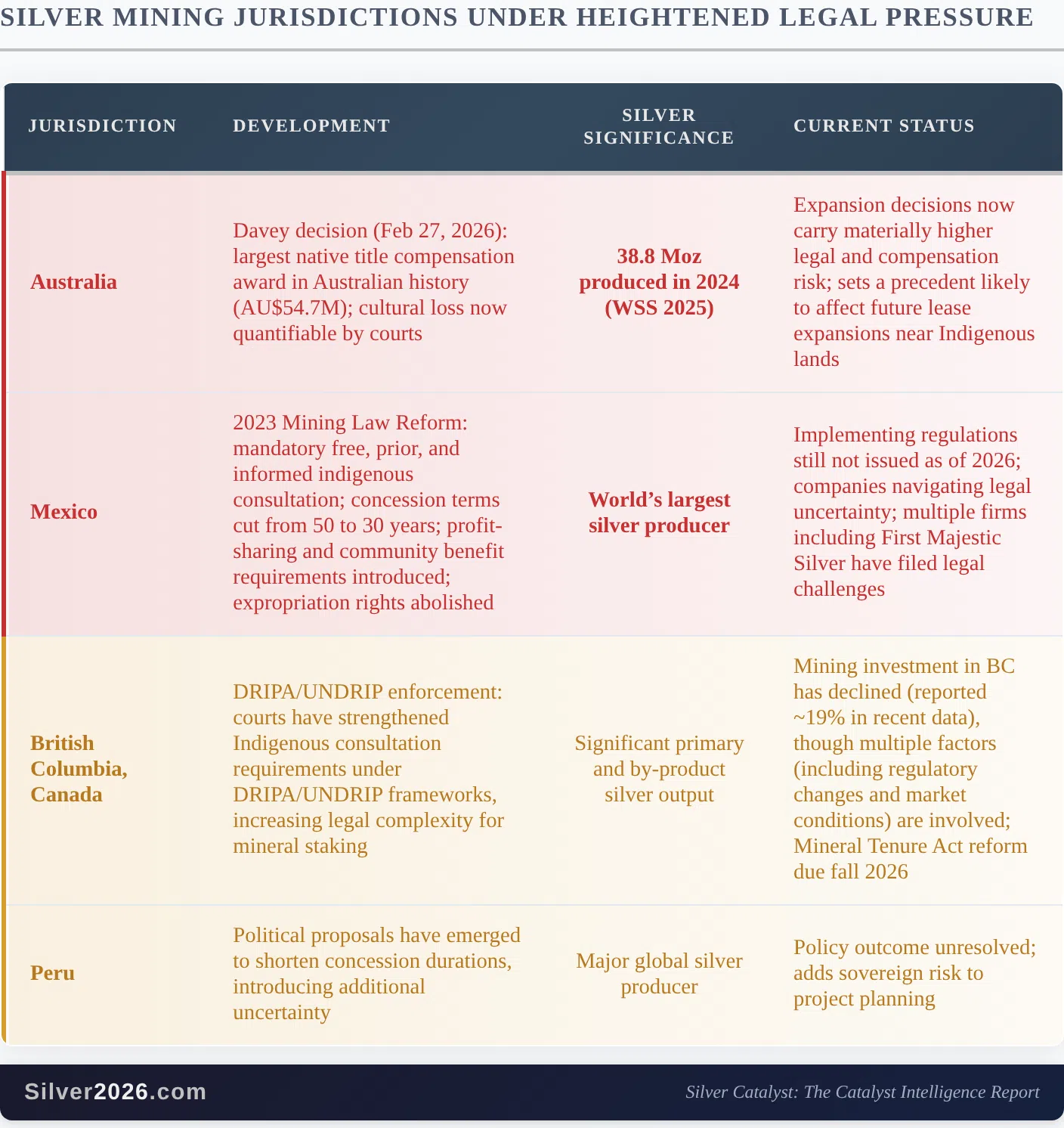
silver mine development:
Sources: Norton Rose Fulbright — Davey decision analysis (March 23,
2026) | Norton Rose Fulbright — Mexico Mining Law Reform | Chambers and Partners — Mining 2026 Mexico | World Silver Survey 2025 — Silver Institute/Metals Focus
What the table above shows is not a single anomalous event in one
country; it is a pattern. Four of the world’s most significant
silver-producing jurisdictions are each, independently, raising the
legal and regulatory cost of expanding mines near Indigenous or
communal lands. The mechanisms differ: a court ruling in Australia,
a legislative reform in Mexico, a judicial interpretation of a
treaty framework in Canada, an election risk in Peru. But the
directional effect is the same in every case: slower permitting,
higher compensation requirements, greater legal uncertainty at the
point in the project cycle where capital commitments need to be
made.
A decade ago, a mining company planning an expansion in a region
with Indigenous land claims could model a narrow range of legal
risk. Today that range is wider, the floor is higher, and the
timeline from approval to first production has another variable
inserted into it. Each additional variable adds months or years. And
as the previous article in this series showed, the silver supply pipeline already operates on
development timelines averaging 15.7 years from discovery to
production. Inserting additional legal complexity into that pipeline
does not add a rounding error. It adds to a structural lag that is
already one of the most consequential features of the silver market.
The silver price outlook depends, in part, on whether supply can eventually catch up
to demand. The Davey decision is one more data point suggesting it
will be harder and slower to do so than standard mine-development
timelines already implied.
Catalyst #91: Indigenous Land Rights Movements Constraining
Silver Mine Development is now active in a way it was not before February 27. It
joins Catalyst #15: Environmental Regulations Increasing Costs and Catalyst #8: 15.7-Year Mine Development Timeline Preventing
Supply Response in a converging set of supply-side constraints that are
independently verifiable and cumulatively significant.
The Outlook
Silver corrected sharply from its January peak, and the fundamental
picture has not changed during that correction. The sixth
consecutive structural deficit is projected to reach approximately 67 Moz in 2026. The cumulative
shortfall since 2021 is approaching 800 Moz. And the supply side of
the ledger keeps acquiring new constraints: development timelines
extending, legal costs rising, and now a judicial precedent that
raises the price of expansion decisions across one of the world’s
significant silver-producing jurisdictions.
The correction is a price event. The Davey decision is a structural
event. They are not in conflict; they are operating on different
timescales.
The full Silver Catalyst Issue #12 covers five more Deep Dives beyond this one:
China’s elimination of its 9% solar VAT rebate and the two-phase
demand dynamic it creates, the Pan American Silver La Colorada PEA
and why its 2034 production start is the clearest possible
activation of the mine development timeline thesis, the US EV
(Electric Vehicle) sales collapse (–28% in Q1) against a 57%
hybrid surge, India’s SEBI reform and the new institutional demand
channel it opens across a $950 billion mutual fund industry, and the
Iran war’s Phase 2 stagflation dynamic and what the April 10 CPI
print will signal. If you want the full structural picture and what
it means from here, you can access it below:
👉 Get Silver Rising with complimentary 2-week Silver Catalyst
access
Thank you.
The Silver Engineer
Investorideas.com
is the go-to platform for big investing ideas. From breaking stock
news to top-rated investing podcasts, we cover it all.
Mining stocks -Learn more about our news, PR and social media,
podcast and content services at Investorideas.com