
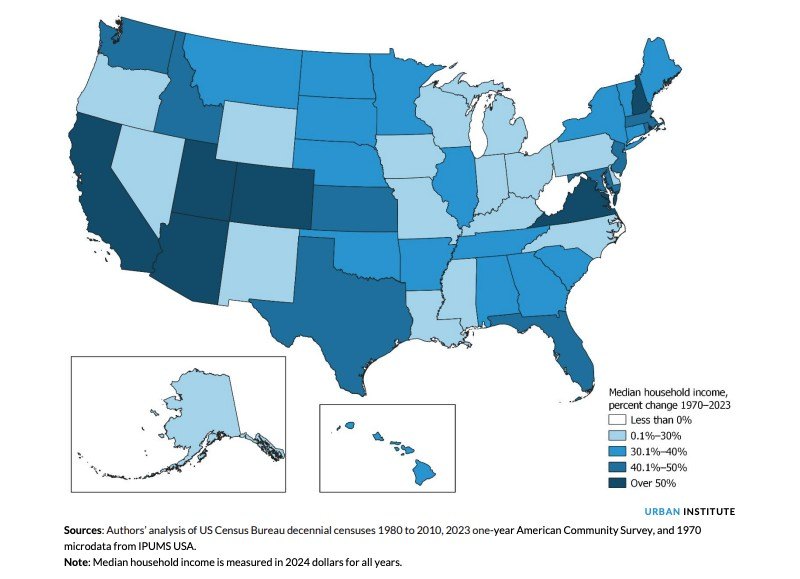
The typical American family earns nearly $20,000 more in inflation-adjusted annual income today than it did in 1970, but growth has varied widely across the 50 states, with some faring far better than others—and in one, households are actually worse off now than they were half a century ago.
The Urban Institute’s Housing and Communities Division published a new study analyzing data from the U.S. Census Bureau, the American Community Survey, and the Integrated Public Use Microdata Series (IPUMS) to determine how median household incomes have changed from 1970 to 2023 in all 50 states.
The bottom line is that Western, Mid-Atlantic, and New England states have seen the steepest income growth since 1970, while Midwestern states have seen the weakest gains.
West Virginia was the only state in the nation where median income declined, slipping from $56,161 in 1970 to $55,948 in 2023 in inflation-adjusted dollars—a 0.4% drop.
The biggest winner of the period covered by the study was Utah, where median household income climbed a staggering 77.6%, from $52,602 to $93,421 annually. Families in Colorado fared similarly well, seeing their incomes grow nearly 67%, from $55,766 to $92,911.
Incomes in New Hampshire gained just over 62%, followed by California at 61%, with Arizona rounding out the top five at 60.2%.
Other states that saw strong income growth included Texas (48.5%); Idaho (48%); Massachusetts (47.7%); and Washington (45.9%).
On the other side of the spectrum, not counting West Virginia, where incomes were in the red by 2023, Michigan households experienced the smallest increase in inflation-adjusted income from 1970 to 2023, at just 2.9%, from $67,235 to $69,183—a gain of less than $2,000.

Missouri fared slightly better: There, the median income grew by 13.3%, reaching $68,545.
Indiana’s growth rate was the fourth-slowest in the U.S., at just 14.1%, followed by Pennsylvania, at 15.2%
Additional states that saw moderate income gains over the course of 53 years were Ohio (16.6%); Alaska (18.4%); Wisconsin (18.7%); Iowa (20.4%); and Mississippi (22.4%).
The rest of the states fell somewhere in the middle, experiencing income gains roughly of 25% to 45%.
Nationally, the median household income in 2023 was $77,719, up approximately 32%—or some $18,000—compared with 1970.
What’s driving the uneven income growth?

According to the authors of the 10-page analysis, Brett Theodos and Brady Meixell, educational attainment was the most critical factor driving income growth on the state level.
“The states with larger increases in residents with bachelor’s degrees tended to be those with larger increases in median household income,” reads the study.
The other key factor most strongly associated with household income gains was the share of immigrants in the state population.
“This could be because immigration leads to economic growth, immigrants seek out growing areas, or both,” write the researchers.
Contrary to conventional wisdom, states with colder temperatures and higher property taxes saw greater median income growth than their counterparts with warmer climates and lower property taxes.
The study also found that state sales and income taxes had no bearing on household income changes.
Utah. vs. West Virginia

Based on the study, changes in natural resource extraction appear to have made a difference in income growth in Utah and West Virginia.
In the 1970s, the top coal-producing states were West Virginia, Kentucky, and Pennsylvania. A decade later, coal output declined in these states but surged in Wyoming, Montana, Texas, Colorado, and Utah.
Unlike Appalachian states, however, Utah did not traditionally rely on coal jobs to prop up its economy, so when this industry went into decline, it did not hit the Beehive State as hard as it did West Virginia.
Additionally, Utah had booming technology and financial sectors to keep the state’s diversified economy humming and its household incomes growing at a healthy pace.
“Overall, the findings of our analysis likely justify states’ focus on education spending and workforce development while suggesting that lowering tax burdens is less effective at stimulating income growth,” conclude Theodos and Meixell.
How does income growth relate to housing affordability?
Perhaps surprisingly, robust income growth does not translate into greater housing affordability. In fact, the opposite is often true.
As of December 2025, Michigan, Missouri, and West Virginia all had housing affordability scores higher than the national average, according to Realtor.com® data.
“Even though incomes in these states have fared poorly since the ’70s, housing prices have remained low enough that buying a home is easier than in the country at large,” says Realtor.com senior economist Joel Berner.
In July, West Virginia posted the lowest median list price in the U.S. of just $270,000. According to Realtor.com data analysis, to become a homeowner in the Mountain State without overspending, a household needed to earn about $71,000 a year, which was 18% higher than the state’s actual median income.
Meanwhile, Utah, Colorado, and New Hampshire were all less affordable than the U.S. as a whole.
“Income growth in these states has sparked run-ups in home prices that make their income growth less meaningful from a housing perspective, as it is still relatively difficult for residents to afford a home,” adds Berner.