
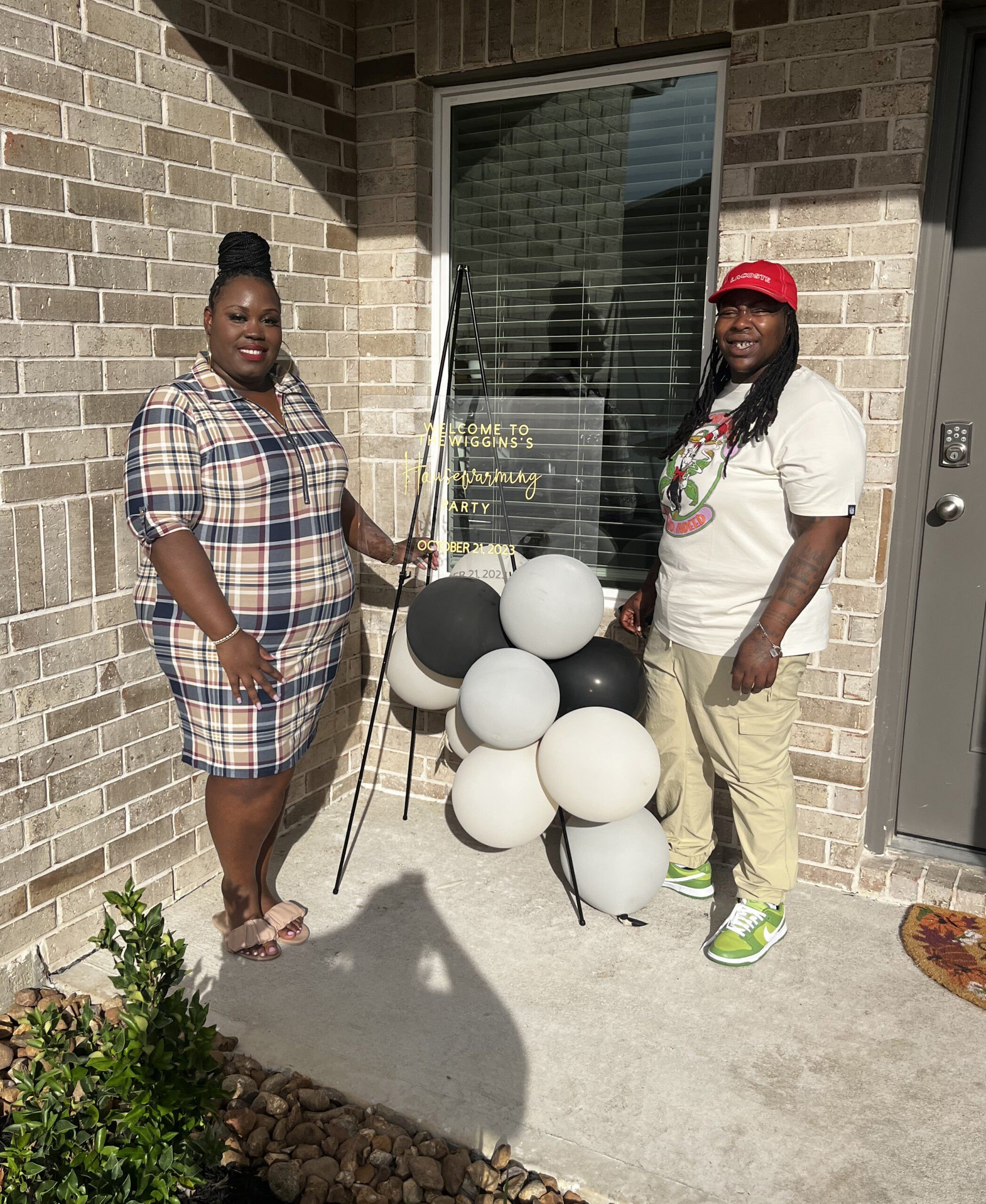
For Houston mother-of-two Raysall Wiggins, President Donald Trump‘s crackdown on institutional homebuyers is a deeply personal victory after she was outbid 20 times by investors during a grueling two-year search for her first home.
“I had to go through hell and high water, and I don’t feel like for the average American, they should have to go through all that,” Wiggins tells Realtor.com®.
Although a new report from Realtor.com shows that corporate buying activity has a shrinking footprint, accounting for just 1% of all single-family home purchases nationwide and is deeply clustered, large-scale investors’ presence can feel overwhelming in specific neighborhoods as they compete with individual home shoppers like Wiggins.
Realtor.com senior economist Jake Krimmel stresses, however, that this is the exception, not the rule.
Wiggins has emerged as the public face of Trump’s anti-investor policy and attended the State of the Union address as a guest of the president, who cited her experience competing with—and repeatedly losing to—institutional investors.
“She placed bids on 20 homes, and lost all those bids to gigantic investment firms that bypassed inspection, paid all cash, and turned those houses into rentals, stealing away her American dream,” Trump said during his record-setting two-hour speech. “Stories like this are why last month, I signed an executive order to ban large Wall Street investment firms from buying up, in the thousands, single-family homes.”
David vs. Goliath in Houston
Wiggins and her real estate agent, Vachael Starks, began shopping for homes in 2021, initially focusing their search on Houston’s Acres Homes neighborhood where Wiggins was renting at the time and where her children were attending school.
Starks says at the outset, her client’s budget was $220,000, but as she started getting outmatched, Wiggins was forced to boost her offer to $250,000—and still it was not enough because she was going up against deep-pocketed institutions with tens of thousands of dollars more to spend.
In one instance, Wiggins says she was outbid by as much as $38,000 cash, a margin that would leave an average mortgage holder “upside down.”
After nearly six months of losing home after home to investors, Wiggins turned her back on the homebuying process in frustration.
“I was depressed. I was upset. I felt like a failure,” she says.
While Wiggins took a step back, her agent diligently continued scouring the market for affordable properties, hoping to finally deliver a win.
“It was very disheartening, because here you are trying to get the American dream and those same houses that you bid on turned around and became rentals,” Starks tells Realtor.com.
Ultimately, Wiggins was forced to leave her preferred community of Acres Homes, requiring her sons to switch schools. In 2023, she pivoted to new construction, which allowed her to avoid bidding wars and access below-market mortgage rates.
However, Wiggins had to take a part-time job just to afford the $265,000 price tag of her three-bedroom, two-bathroom home.
Both Wiggins and Starks say they came out of this experience supporting Trump’s executive action aimed at blocking institutional investors.
“I would love for it to become law so it can be set in stone, so no one else has to go through what I went through,” says Wiggins.
Starks points out that while she has never supported Trump politically, she is strongly in favor of keeping corporate investors out of single-family housing markets.
“They are ruining the market. Period,” she says.

Institutional investors’ shrinking footprint
The latest analysis of deed records dating back to 2000 reveals that large-scale investors are playing a diminishing role in the housing market that’s mostly limited to inventory-rich Sun Belt states.
Institutional investors—defined by Realtor.com researchers as those that have scooped up more than 350 single-family homes since 2015—accounted for just 1% of total sales across the U.S.
The 350-purchase benchmark is a key provision in the 21st Century Road to Housing Act—a bipartisan housing reform package that the U.S. Senate passed in an 89-10 vote on Thursday, moving it one step closer to adoption.
The bill still faces many hurdles. It must be reconciled with the House version before it can be sent to Trump’s desk.
In Wiggins’ hometown of Houston, Wall Street buyers snapped up over 41,000 single-family homes since 2015, ranking the Texas metro third in the nation for investor footprint.
But despite the seemingly high purchase volume, institutional players accounted for just 2.7% of the sprawling metro’s total sales from 2015 to 2025. Within the investor market specifically, corporate purchasers made up 23% of sales, about half the share of “mom and pop” buyers—those with fewer than 10 properties in their portfolios.
What the study of the Houston housing market reveals is that institutional buying is not spread evenly and is narrowly focused in specific suburban enclaves, with the top 10% of the metro’s ZIP codes for investor activity accounting for roughly 40% of all institutional sales, according to the report.
In the top five most investor-targeted communities, their share of single-family purchases ranged from 3.6% to 5.8%, demonstrating that individual buyers still accounted for the vast majority of closings.
“This suggests that institutional capital is primarily competing with other investors for a specific type of inventory, rather than displacing the typical individual homebuyer on a mass scale,” says Krimmel.
Across the 50 top metros, Memphis, TN, stood out as the No. 1 hotbed of mega-investor activity, but even there just 4.4% of single-family homes were purchased by institutional players since 2015.
Overall, the study of deed records at the national, state, and metro levels shows that from 2015 to 2025, mom-and-pop investors accounted for 53% of investor activity nationwide, emerging as the dominant force.
Medium and large investors, defined as those with 10 to 50 and 51 to 10,000 purchases, respectively, combined for roughly 35% of single-family closings. Meanwhile, institutional investors trailed far behind, accounting for just 12% of the investor segment.
Even at the peak of their activity in 2021, mega-buyers were responsible for just 16% of all investor purchases.
Trump’s mega-investor crackdown

Despite large-scale buyers’ diminishing role in the single-family housing market, in late January, Trump signed an executive order placing limits on what he called “large Wall Street investors,” whom he accused of “crowding out families” from homeownership.
While the policy addresses concerns that corporate buyers are sidelining traditional homebuyers and intensifying the affordability crisis, Realtor.com research suggests that given institutional investors’ minuscule footprint in the single-family segment, the overall impact of Trump’s ban may do little to move the needle.
For context, over the last 10 years, there were roughly 5.5 million investor purchases in the U.S., with institutional players accounting for just 400,000 homes bought. Meanwhile, there were 58 million noninvestor closings during the same period.
Therefore, according to Krimmel, the executive order reflects something of a “misdiagnosis” of the real issues constraining homeownership: decades of underbuilding that have left the housing market critically short of supply, elevated borrowing costs, and zoning and regulatory policies that continue to dampen new construction.
“These structural factors shape housing affordability far more powerfully than the participation of a relatively small and recently shrinking class of institutional buyers,” says the economist.
Krimmel acknowledges that while policymakers’ focus on Wall Street is understandable, given that these behemoth firms operate differently from mom-and-pop landlords and leave many Americans feeling sidelined, the data tells a different story. Ultimately, corporate buyers lack the market scale to significantly shift inventory levels or housing affordability.
Sun Belt markets are drawing large investors

The report shows that this is true not only nationally, but also in local markets boasting the nation’s highest concentrations of mega-investor buyers, led by Memphis, where they accounted for just over 4% of all single-family purchasing activity.
Colorado Springs, CO, saw the second-highest share of institutional purchases, at 4.3%, followed by Charlotte, NC, at 4.2%.
Looking at corporate homebuying by volume, Dallas led the way with 66,000 properties, followed by Atlanta (58,000) and Houston (42,000).
Harrison Polsky of Catēna Homes, a luxury residential builder in Dallas, says the city’s appeal to big-time investors is apparent.
“The combination of zero state income tax, a business-friendly regulatory environment, and a cost of living that is a fraction of comparable coastal markets creates a financial freedom that no one can ignore,” he tells Realtor.com.
Polsky says that the influx of institutional capital and ultrawealthy individual buyers into the Dallas metro is compressing an already undersupplied market.

“For local buyers, particularly those trying to break into neighborhoods like the Park Cities or Preston Hollow, the runway is getting shorter but more severely nonexistent,” he says. “What might have been attainable three or four years ago has in many cases moved out of reach.”
Seeking to put the impact of investors in perspective, Krimmel emphasizes that their share of total home purchases remains in the low single digits.
Additionally, investor magnets like Memphis and Colorado Springs are located in the Sun Belt, where supply has been on the rise in recent years.
On the other hand, in pricey, inventory-starved coastal metros like New York City and San Diego, institutional investor activity is virtually nonexistent—in part due to those cities’ robust tenant protections or rent stabilization laws—meaning the Trump administration’s restrictions would have little real impact on supply levels and affordability.
It’s important to note that institutional investment activity fluctuates based on interest rates and home prices. While mega-buyers have pulled back recently due to higher borrowing costs, they are known for innovating and finding regulatory loopholes.