
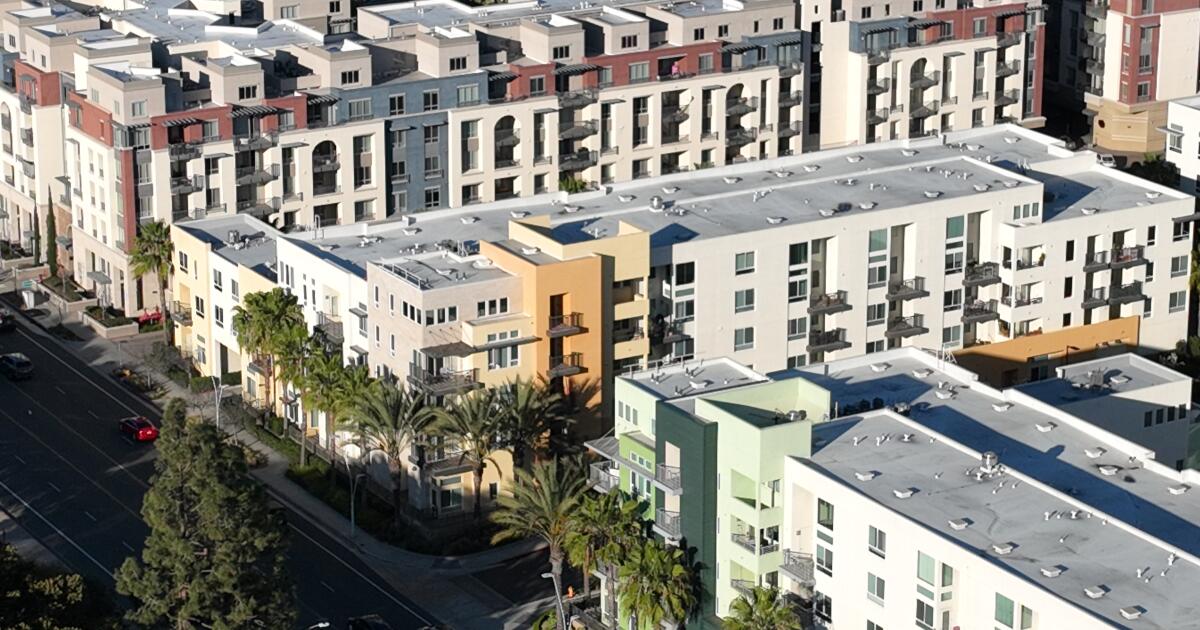
Since Gov. Gavin Newsom signed SB 79 into law last year, L.A. officials have been developing a strategy to stop its upzoning effects: Delay.
The historic bill, which overrides local zoning laws to allow for taller, denser buildings near transit stops, represented a jarring shift for Southern California, a region built on the promise of suburban sprawl and single-family housing. But the bill’s authors included some flexibility for cities, including the ability to delay the upzoning until 2030 if cities add density on their own terms.
That’s exactly what L.A. is planning to do.
On Tuesday, City Council voted to adopt a strategy that would delay the effects of SB 79 citywide by upzoning 55 single-family and low-density areas, allowing for 4-16 unit buildings up to four stories tall. The 55 areas are mostly in Central L.A., West L.A., the Eastside and the San Fernando Valley.
In other words, it adds a little density, but not as much as SB 79, which allows developers to build up to nine stories for buildings adjacent to certain transit stops, seven stories for buildings within a quarter-mile and six stories for buildings within a half-mile.
“While we as a body opposed SB 79 … the reason for it was legitimate. It’s to create more opportunities for housing construction and focus development in areas of high-quality transit,” said Councilmember Bob Blumenfield. “That is a worthy goal.”
The plan, pushed by homeowners wanting to mitigate the upzoning, was one of three options developed by the Department of City Planning that the council was considering. It offers the potential for density in areas where it hasn’t been allowed, but pro-housing advocates say the plan is the least ambitious of the three.
The second option would have added the same provisions as the first, but also permitted buildings as tall as eight stories within a half-mile of 23 transit stops around L.A. The third option, pushed by housing groups, was the most aggressive, adding the same provisions as the first but permitting buildings as tall as eight stories within a half-mile of 55 transit stops.
SB 79 allows local governments to develop alternate plans to maintain local control of density near transit stops. Assuming there’s no pushback from Sacramento, the plan adopted by City Council will allow L.A. to kick the proverbial can down the road, delaying SB 79 until 2030. If the council hadn’t adopted a plan, the area surrounding 141 transit stops across L.A. would have immediately been upzoned when the bill kicks in on July 1.
The bill was loaded with carve-outs and exemptions for certain areas — a product of the scramble to eke out votes and push it through the Legislature — and the city could have delayed upzoning in 88% of the 141 sites for various reasons, such as being in a very high fire severity zone or a historic preservation overlay zone, but the remaining 12% would have been upzoned in July. So the City Council’s plan stops upzoning in the 12% and spreads out potential for lighter-density across 55 areas instead
The plan adopted Tuesday expands the Opportunity Corridor Transition Area, a provision in the Citywide Housing Incentive Program that incentivizes developers to build small, multifamily housing projects near transit. At the City Council meeting, however, critics pointed out during public comment that no housing has actually been built under the provision, so there probably won’t be any built under the newly adopted strategy.
In response to criticism of the provision’s effectiveness, Councilmember Katy Yaroslavsky introduced a motion to expand its incentives so developers actually build the newly legalized housing types, potentially allowing for higher, denser projects.
“[This] is phase one. It adds meaningful housing capacity now and gives us time to decide where the rest of the density should go within our own communities,” Yaroslavsky said. “I’m not interested in passing [this option] today, giving ourselves a pat on the back and calling it a day for four years. If this doesn’t result in housing that gets built, none of this matters.”
That motion, as well as a motion to accelerate upzoning in high-opportunity areas before 2030, will move to the Planning and Land Use Management Committee.
Times staff writer David Zahniser contributed to this report.