
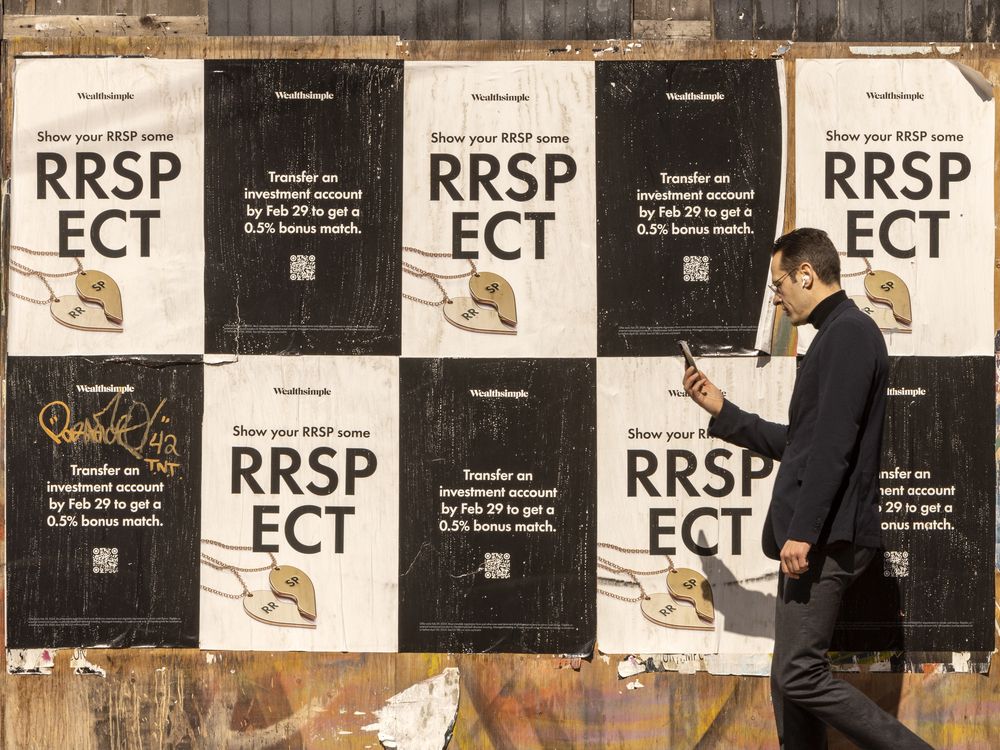
With the start of the 2026
registered retirement savings plan
(RRSP) season, I’m reminded of a meeting a couple of years ago. I met with a client who was interested in learning more about a
often referred to as an “immediate financing arrangement.” The plan involves leveraging the cash value of a permanent life insurance policy to provide immediate access to capital, typically for investment or business purposes.
The client loved the concept, and asked me if I had any more “great” tax ideas for him. I started by saying that I assume he had fully maxed out his RRSP contributions, at which point he interrupted me, and said, emphatically, “
.”
I was dumbfounded. Didn’t believe in RRSPs? It’s not like it’s a religion. So, I asked him to clarify.
He went on to explain that, in his view, RRSPs were “useless” because when you withdraw the funds in retirement you have to pay tax on the full value of the amount withdrawn. And if you should be so unlucky as to die with a large RRSP, or its successor a large
registered retirement income fund
(RRIF), then the government takes more than half of it in most provinces (for values above $258,482 in 2026).
After I calmed down, I patiently tried to walk the client through
why the RRSP should be a no-brainer
for nearly every Canadian, the only possible exception being taxpayers with limited funds to contribute and who may prefer a
(TFSA) over an RRSP.
Although the client was correct in that
you do pay tax on RRSP withdrawals
, it’s important to keep in mind that you also got a tax deduction when you contributed. If your tax rate is the same in the year of contribution that it is in the year of withdrawal, an RRSP provides a completely tax-free rate of return. If your tax rate is lower in the year of withdrawal, you’ll get an even better after-tax rate of return on your RRSP investment. In fact, even if your tax rate is higher in the year of withdrawal, as I’ve shown in my report
Just do it: The case for tax-free investing
, given a long enough period of tax-free compounding, you are still be ahead of the game with an RRSP over investing in a non-registered account.
To illustrate the hands-down advantage of an RRSP over non-registered investing, consider the following example. Let’s assume you earned $3,000 of employment income in 2025, have a 33.33 per cent marginal tax rate, and your investments grow at five per cent over the course of the year. If you invested in an RRSP, you would not pay tax on your income so you would have the full $3,000 to invest.
Growth of five per cent would increase the value of your RRSP investment after the first year by $150 ($3,000 times five per cent) to a value of $3,150. If you were then to cash in your RRSP by withdrawing the funds, you would pay tax of $1,050 (33.33 per cent on the full $3,150 withdrawn from the RRSP), leaving you with $2,100 after-tax.
Now, let’s compare that to the non-registered account, which some taxpayers believe is a better choice since capital gains are only 50 per cent taxable. If instead you chose to invest your $3,000 of employment income in a non-registered account, you would pay upfront tax of $1,000 ($3,000 times 33.33 per cent) on your $3,000 of income, leaving only $2,000 to invest.
At the same five per cent rate of return, your non-registered investment would have grown by $100 ($2,000 times five per cent), making your account worth $2,100 at the end of the year. If you were to then cash in your non-registered investment, assuming that the five per cent growth was in the form of a 50 per cent taxable capital gain, you will pay tax of about $17 (50 per cent times $100 times 33.33 per cent), yielding $2,083.
As we can see, the value of non-registered investment ($2,083) after-tax, is worth less than the value of the RRSP ($2,100), meaning your RRSP has effectively given you a tax-free return of $100 (five per cent) on your “net investment” of $2,000 (being the $3,000 you contributed less the 33.33 per cent tax you paid).
Another way to think of it is to consider your RRSP a partnership between you and the government. Retired Ottawa accountant Paul Rastas has more than 50 years’ experience in Canadian tax planning and compliance, and for years has been trying to help Canadians better understand the mechanics of the RRSP. As Mr. Rastas puts it, “Contrary to popular belief, your RRSP statement does not report your investment ‘value’ in real Canadian dollars. It is in ‘RR$P dollars.’ RR$P dollars are analogous to a foreign currency and must be converted to real Canadian dollars before being spendable. The exchange rate is your individual, personal, marginal tax rate.”
Mr. Rastas gives an example of someone who contributes $10,000 to an RRSP. While their RRSP statement may show $10,000, this actually represents (at a 30 per cent marginal rate) a $7,000 investment, plus $3,000 of what he refers to as “pre-paid tax,” due to the CRA upon withdrawal. (The example assumes your tax rate in the year of contribution of 30 per cent is the same as your rate in the year of withdrawal).
If that $10,000 was invested at 7 per cent, a decade later the RRSP would be worth nearly double, or almost $20,000. This $20,000 balance represents the initial $7,000 investment, plus $7,000 of growth, plus the original $3,000 of “pre-paid tax,” plus $3,000 of growth on that. The net $7,000 investment doubled, tax-free, and is now worth $14,000 after-tax. As proof, if the RRSP worth $20,000 is cashed in, tax of 30 per cent, or $6,000, would be paid, leaving $14,000 after-tax.
As a reminder, the 2026 RRSP contribution deadline is Monday, March 2, 2026, if you want to claim a deduction against your 2025 income.
Jamie Golombek,
FCPA, FCA, CFP, CLU, TEP, is the managing director, Tax & Estate Planning with CIBC Private Wealth in Toronto.
Jamie.Golombek@cibc.com
.
If you liked this story,
sign up for more
in the FP Investor newsletter.